
Technology
Ford Embraces Tesla’s Gigacasting to Launch Affordable Electric Truck

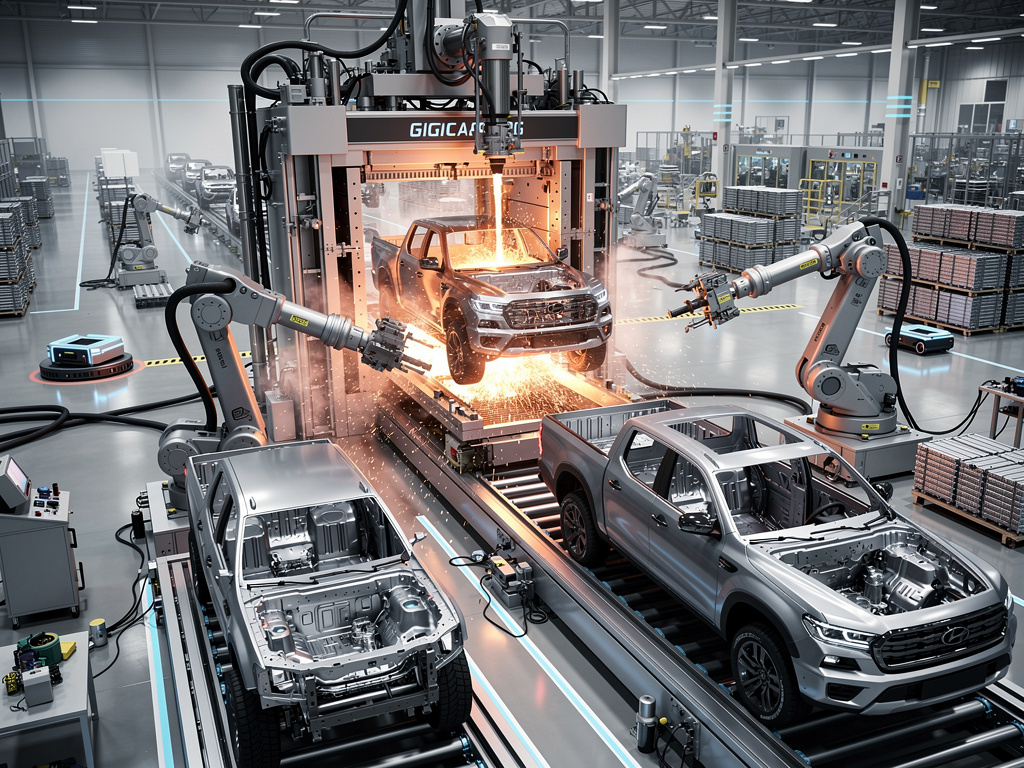
Ford Motor Company is making a significant shift in its manufacturing strategy by adopting the large single-piece casting technology pioneered by Tesla Inc. This move aims to produce an electric pickup truck with a retail price under $25,000. The decision marks a pivotal change for the second-largest automaker in the United States, potentially transforming the economics of electric vehicle (EV) production and heightening competition in the global auto industry.
The Detroit-based automaker has been quietly enhancing its gigacasting capabilities as part of a broader initiative to reduce the cost of electric vehicle production. According to reports, Ford is integrating large die-casting machines that can create substantial structural components of a vehicle’s underbody in one piece. This approach replaces the traditional method, which typically involves numerous stamped and welded parts. The technology, initially implemented at scale by Tesla in its Fremont and Austin factories, has become a focal point for automakers worldwide aiming to simplify assembly, reduce labor costs, and speed up production.
Revolutionizing Production with Gigacasting
Gigacasting, which utilizes massive casting machines exerting between 6,000 to 9,000 tons of clamping force, was introduced by Tesla in 2020 for the Model Y’s rear underbody. This innovative process eliminated approximately 70 individual parts and the related welding and joining steps. Tesla’s CEO, Elon Musk, has consistently highlighted this technology as key to the company’s cost-reduction strategy. The results have been evident: Tesla’s cost per vehicle has declined significantly over recent years, enabling aggressive price cuts that competitors have found challenging to match.
Ford’s transition to gigacasting acknowledges that traditional body-in-white manufacturing—a process involving the stamping and welding of hundreds of components—cannot produce the necessary cost structure for affordable EVs. The company is reportedly collaborating with suppliers, including Italy’s Idra Group, known for manufacturing the large-tonnage casting machines that Tesla popularized. Ford’s objective is to apply this technology to a new electric truck platform designed for high-volume, low-cost production.
The Importance of the $25,000 Price Point
The goal of a sub-$25,000 price tag has become a critical target within the EV sector. Analysts and industry leaders have long contended that the widespread adoption of electric vehicles will hinge on pricing that competes with popular internal combustion engine models. In the United States, the average transaction price for a new vehicle was around $48,000 in early 2024. Notably, the best-selling segments, such as compact trucks and midsize sedans, often sell for significantly less than this average.
A $25,000 electric truck would directly challenge the core of the American vehicle market. Ford’s ambitions are not taking place in isolation. Tesla is developing its affordable model, while Chinese manufacturers like BYD have successfully produced attractive EVs at low price points for their domestic market. For example, BYD’s Seagull is priced around $10,000 in China, although tariffs and regulatory barriers make this price unfeasible in the U.S. market. The competitive pressure from Chinese automakers serves as a significant motivator for Ford and its American competitors.
Financially, the urgency behind Ford’s cost-reduction strategy is palpable. The company’s Model e division, which oversees its electric vehicle operations, reported an operating loss of $4.7 billion in 2024, mirroring a similar loss in 2023. CEO Jim Farley has openly discussed the necessity of restructuring Ford’s approach to EV manufacturing. During earnings calls, Farley emphasized that merely electrifying existing vehicle architectures would not suffice for profitability—Ford must develop purpose-built platforms with drastically lower production costs.
Gigacasting presents one of the most effective means to achieve this goal. By consolidating numerous parts into a single casting, Ford can reduce the number of robots on assembly lines, minimize factory space, shorten production timelines, and lower material costs. The resulting savings are significant: fewer parts lead to fewer suppliers, reduced quality checks, and diminished chances of failure.
Major automakers such as Toyota, Hyundai, and Volvo have also announced their own gigacasting initiatives, indicating a broad industry consensus on the necessity of this technology for next-generation EV platforms.
Challenges and Risks Ahead
Despite its potential, gigacasting brings substantial risks. The large aluminum castings can be challenging to repair if damaged, raising concerns about insurance costs and total-loss rates. Tesla has encountered criticism from body shops and insurers regarding the repairability of its gigacast components. Ford will need to proactively address these concerns to avoid similar backlash.
Additionally, metallurgical challenges exist: producing large, thin-walled aluminum castings with consistent quality requires meticulous control over alloy composition, mold temperature, and injection pressure. Any defective castings could necessitate scrapping an entire underbody structure, which is significantly more costly than discarding a single stamped panel. To mitigate these risks, Ford has invested in advanced simulation and prototyping capabilities. The company has been studying Tesla’s iterative approach to gigacasting, which has involved various generations of casting machines and alloy formulations.
Ford’s Strength in the Truck Market
Ford’s reputation in the truck segment provides a solid foundation for this bold initiative. The F-Series has been America’s best-selling vehicle line for over four decades. Ford’s deep understanding of what truck buyers prioritize—durability, capability, and value—is unmatched. The F-150 Lightning, while notable as one of the first mainstream electric pickups, has faced challenges due to high pricing and production costs, limiting its appeal to a narrow segment of early adopters and fleet buyers.
A sub-$25,000 electric truck would target an entirely different demographic: tradespeople, first-time truck buyers, and small business owners who require a reliable work vehicle but cannot justify spending $55,000 for a Lightning or $50,000 for a Cybertruck. Ford has indicated that this new vehicle may be smaller than the F-150, possibly resembling the discontinued Ford Ranger or even the compact Maverick. The Maverick, which begins at around $25,000 in its hybrid version, has been a remarkable success for Ford, frequently selling out its production runs. An electric variant built on a gigacasting platform could extend that success into the battery-electric market.
Competitive pressures from various directions also complicate Ford’s timeline for bringing a gigacast electric truck to market. The company faces competition not only from Tesla and Chinese manufacturers but also from General Motors, which has heavily invested in its Ultium platform, and from Stellantis, which has announced plans for affordable EVs under the Ram and Jeep brands. Rivian is also developing a smaller, more affordable vehicle platform in partnership with the Volkswagen Group.
The policy environment adds another layer of complexity. Tariff policies have increased the costs of imported components and raw materials, including aluminum, the primary material for gigacast parts. Ford must ensure that its supply chain for casting alloys and equipment is sufficiently domestic or tariff-exempt to maintain the cost advantages that gigacasting is intended to provide. Simultaneously, the future of federal EV tax credits remains uncertain, and any reduction in consumer incentives could make the $25,000 price target even more challenging to achieve.
Ultimately, Ford’s commitment to gigacasting represents a declaration of the company’s vision for the future. Instead of retreating from the electric vehicle market amid significant losses—an option some analysts and investors have suggested—Ford is investing in the belief that electric vehicles will dominate the mass market, provided they can be produced at costs comparable to gasoline-powered vehicles. Gigacasting stands out as the most promising manufacturing technology to bridge that gap.
The stakes are high. If Ford successfully launches a sub-$25,000 electric truck with acceptable profit margins, it will achieve a milestone that no legacy automaker has yet accomplished: creating an affordable, profitable electric vehicle for the American market. Conversely, if the initiative encounters technical difficulties, cost overruns, or market shifts, it could add billions to the losses already incurred by Ford’s EV division and raise serious questions about the company’s strategic path. For now, Ford is betting that the same casting technology that helped Tesla redefine EV manufacturing can similarly benefit the Blue Oval.










Antarctica’s Gravity Anomaly Sheds Light on Earth’s Interior Dynamics

Muscle Power Linked to Longevity: A New Health Insight

LightPath Technologies Outperforms Axion Power in Key Metrics

Dive into Self-Discovery with Proust on The Cosmic Library

Kendall Jenner Dazzles in Bold Crop Top for Vogue France

Avidity Biosciences Set to Release Q4 Earnings on February 26

Sleep Apnea: Understanding a Hidden Health Challenge

Bitcoin Faces Critical Test as Fear & Greed Index Plummets to 5

AAUW Grant Recipient Kate McKinney Inspires Future Mathematicians

Nostradamus’ 2026 Predictions: Star Death and Dark Events Loom

OpenAI to Implement Age Verification for ChatGPT by December 2025

Discover the Top 10 Calorie Counting Apps of 2025

Electric Moto Influencer Surronster Arrested in Tijuana

Bella Hadid Shares Health Update After Treatment for Lyme Disease

Breakthroughs and Challenges Await Science in 2026

Analysts Project Stronger Growth for Apple’s iPhone 17 Lineup

Top 10 Penny Stocks to Watch in 2026 for Strong Returns

Harvard Secures Court Victory Over Federal Funding Cuts
-
 Science2 months ago
Nostradamus’ 2026 Predictions: Star Death and Dark Events Loom
-
 Technology3 months ago
OpenAI to Implement Age Verification for ChatGPT by December 2025
-
 Technology7 months ago
Discover the Top 10 Calorie Counting Apps of 2025
-
 Technology5 months ago
Electric Moto Influencer Surronster Arrested in Tijuana
-
 Health5 months ago
Bella Hadid Shares Health Update After Treatment for Lyme Disease
-
 Science2 months ago
Breakthroughs and Challenges Await Science in 2026
-
 Health6 months ago
Analysts Project Stronger Growth for Apple’s iPhone 17 Lineup
-
 Technology2 months ago
Top 10 Penny Stocks to Watch in 2026 for Strong Returns
-
 Education6 months ago
Harvard Secures Court Victory Over Federal Funding Cuts
-

 Health6 months ago
Erin Bates Shares Recovery Update Following Sepsis Complications
-

 Science4 months ago
Starship V3 Set for 2026 Launch After Successful Final Test of Version 2
-

 Technology7 months ago
Meta Initiates $60B AI Data Center Expansion, Starting in Ohio