
Science
Researchers Uncover Origins of Hot Jupiters’ Close Orbits

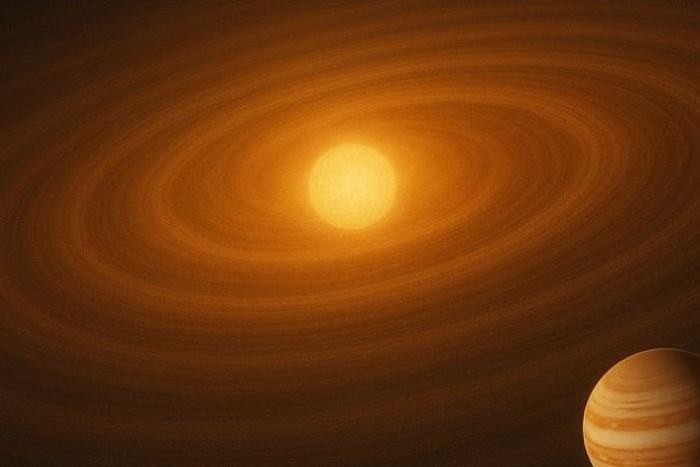
A recent study published in The Astronomical Journal enhances our understanding of hot Jupiters—gas giant exoplanets that orbit very close to their stars. Researchers from The University of Tokyo examined the orbital evolution of these planets to determine their origins. This investigation addresses how hot Jupiters ended up in such close proximity to their host stars, a phenomenon that has puzzled scientists since the first exoplanet was confirmed in 1995.
The study focused on more than 500 hot Jupiters, employing mathematical models to analyze two main processes: disk migration and high-eccentricity migration (HEM). Disk migration occurs when a planet’s orbit changes while within the protoplanetary disk surrounding its star. In contrast, HEM describes the transition of a planet’s orbit from an elongated shape to a circular one.
Through their analysis, the researchers explored the timescales of these orbital transformations in relation to the age of the planetary systems. They discovered that for the majority of the hot Jupiters studied, the time required to transition from a highly-eccentric orbit to a circular one was less than the age of the system. However, around 30 hot Jupiters did not conform to this pattern, indicating that their orbital evolution could take longer than the system’s age.
Moving forward, the researchers emphasize the need for a larger sample size and further exploration of the obliquity—or tilt—of protoplanetary disks. This could provide critical insights into the mechanisms behind disk migration. The team also highlighted the significance of analyzing archival data from NASA’s now-retired Kepler telescope and the ongoing Transiting Exoplanet Survey Satellite (TESS) mission.
Hot Jupiters are particularly intriguing as they do not resemble any planets within our solar system. Unlike Jupiter, which orbits far from the Sun, hot Jupiters have orbits that can range from just 1 to 10 days, with some even completing an orbit in less than a single day. This unique characteristic challenges existing models of planetary formation and evolution.
Historically, the ratio of hot Jupiters to other types of exoplanets was significantly skewed due to the limitations of early detection methods. While this disparity has decreased, the origins of hot Jupiters remain an area of active research. Scientists continue to debate whether these planets formed close to their stars or migrated inward from more distant locations.
Although hot Jupiters and any potential moons are unlikely to support life as we know it due to their extreme temperatures, studying them could yield valuable information about exoplanet formation. As research progresses, the scientific community anticipates exciting new findings that could reshape our understanding of these fascinating celestial bodies. The journey of exploration into the mysteries of hot Jupiters is just beginning, with the potential for groundbreaking revelations in the years ahead.







San Diego Zoo and Illumina Launch DNA Sequencing for Biodiversity

Islamic Organization Distributes Materials at Texas High School

San Antonio Artists Bring Supplies and Solidarity to Cuba

Larvae Exhibit Social Behavior Changes Based on Environment

Supplements for Metabolic Health: Understanding Their Role

Researchers Measure Cosmic Radiation’s Impact on Dark Clouds

CISA Urges Immediate Action on Critical SolarWinds Security Flaw

Nichols College Students Gear Up for Super Bowl Experience

Alma’s Kylee Lineberry Competes in Miss Arkansas Tech Pageant

Nostradamus’ 2026 Predictions: Star Death and Dark Events Loom

OpenAI to Implement Age Verification for ChatGPT by December 2025

Discover the Top 10 Calorie Counting Apps of 2025

Bella Hadid Shares Health Update After Treatment for Lyme Disease

Analysts Project Stronger Growth for Apple’s iPhone 17 Lineup

Electric Moto Influencer Surronster Arrested in Tijuana

Harvard Secures Court Victory Over Federal Funding Cuts

Erin Bates Shares Recovery Update Following Sepsis Complications

Meta Initiates $60B AI Data Center Expansion, Starting in Ohio
-
 Science1 month ago
Nostradamus’ 2026 Predictions: Star Death and Dark Events Loom
-
 Technology2 months ago
OpenAI to Implement Age Verification for ChatGPT by December 2025
-
 Technology7 months ago
Discover the Top 10 Calorie Counting Apps of 2025
-
 Health5 months ago
Bella Hadid Shares Health Update After Treatment for Lyme Disease
-
 Health5 months ago
Analysts Project Stronger Growth for Apple’s iPhone 17 Lineup
-
 Technology5 months ago
Electric Moto Influencer Surronster Arrested in Tijuana
-
 Education5 months ago
Harvard Secures Court Victory Over Federal Funding Cuts
-
 Health5 months ago
Erin Bates Shares Recovery Update Following Sepsis Complications
-
 Technology7 months ago
Meta Initiates $60B AI Data Center Expansion, Starting in Ohio
-

 Technology6 months ago
Discover How to Reverse Image Search Using ChatGPT Effortlessly
-

 Science4 months ago
Starship V3 Set for 2026 Launch After Successful Final Test of Version 2
-

 Technology7 months ago
Recovering a Suspended TikTok Account: A Step-by-Step Guide