
Science
European Space Agency Plans Bold Mission to Interstellar Comet

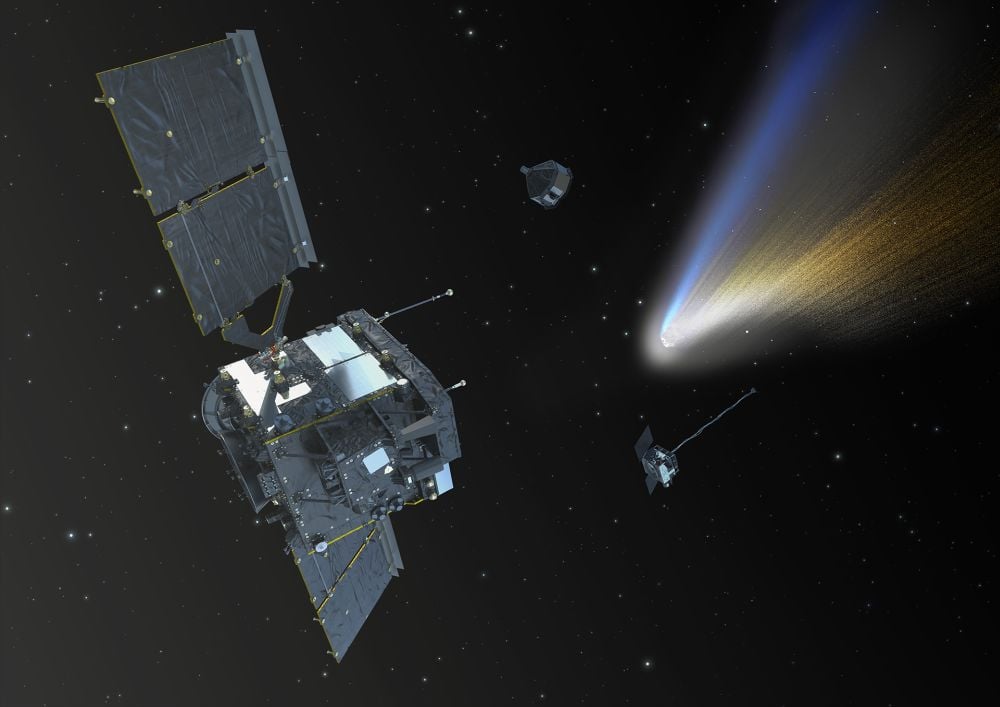
The European Space Agency (ESA) is set to launch its innovative Comet Interceptor Mission in 2029. This mission aims to wait for a long-period comet to arrive in the inner Solar System and then embark on a trajectory to rendezvous with it. These ancient comets are believed to contain material largely unchanged by time, offering vital insights into the formation of our Solar System.
A recent white paper titled “Intercepting Interstellar Objects” outlines how this Comet Interceptor could also be utilized to engage with an Interstellar Object (ISO), such as comet 3I/ATLAS. The paper has been submitted to the UK Space Frontiers 2035 prioritisation exercise and highlights the mission’s potential to revolutionize our understanding of cosmic bodies.
The first successful attempt to study a comet with a spacecraft occurred in September 1985, when NASA’s International Cometary Explorer (ICE) passed through the tail of comet Giacobini-Zinner. While this mission did not capture any images, it set the stage for subsequent missions. NASA’s Stardust mission in 1999 became the first to return samples from a comet, delivering dust grains to Earth in 2006. Other notable missions include NASA’s Deep Impact to comet Tempel 1 and ESA’s Rosetta mission to comet 67P/Churyumov-Gerasimenko.
What differentiates the Comet Interceptor mission is its unique launch strategy. Rather than targeting a specific comet, it will be launched into space and remain on standby until a suitable long-period comet is discovered. This readiness makes it particularly adept at approaching ISOs, which enter the inner Solar System with little advance notice and do not linger for long.
The authors of the study emphasize that “Comet Interceptor will wait in space until a suitable long period comet is discovered, allowing rapid response to perform a fast flyby of an object that will be in the inner Solar System for only a few years.” This capability could enable the first in situ investigation of a visitor from another star system, providing a rare opportunity to glean knowledge about the formation processes of planets in different environments.
Comets and asteroids serve as remnants of the planet-building process, providing crucial insights into the early conditions of the Solar System. The icy bodies of comets, often preserved in frigid conditions far from their stars, are particularly valuable for this purpose. The study of ISOs could reveal similarities and differences in planetary formation across the galaxy, enhancing our understanding of how our Solar System fits within a broader cosmic context.
The white paper highlights that ISOs present a unique opportunity to study the building blocks of other planetary systems. Researchers believe that during a solar system’s formation, many icy bodies are ejected, which can lead to the creation of interstellar comets like 2I/Borisov and 3I/ATLAS. The galaxy may be filled with these comets, but they have only recently begun to be detected.
The authors point out that existing proposals for missions to chase known ISOs are impractical, relying on untested maneuvers and propulsion systems. They assert that a realistic attempt to rendezvous with an ISO must involve a spacecraft that is already in place, such as ESA’s Comet Interceptor.
The Comet Interceptor mission is designed to be relatively inexpensive and could potentially be launched alongside a larger payload. While the instrumentation for an ISO mission would be similar to that of the Comet Interceptor, it would also require a neutral mass spectrometer to analyze the unique compositions of interstellar comets.
While it is unlikely that the Comet Interceptor, scheduled for launch in 2029, will encounter an interstellar comet, the authors suggest that the mission could serve as a blueprint for future missions aimed at studying these cosmic visitors. They argue that there is significant scientific and public interest in ISO missions, and the Comet Interceptor could provide a proof of concept for the “wait in space” approach.
As scientists work to better understand the population of ISOs, the upcoming operations of the Vera Rubin Observatory and its Legacy Survey of Space and Time are expected to detect at least ten ISOs, with the potential for many more. The data gathered will help refine our understanding of the true population size and the waiting time necessary to find a reachable ISO.
A mission to an interstellar comet should be a high priority, according to the authors. The exploration of such bodies could reveal groundbreaking information about the origins of life and the ingredients for life beyond our Solar System. The findings from previous comet missions, such as the detection of amino acids on comet 67P/Churyumov-Gerasimenko, suggest that life’s building blocks may be more widespread than once thought.
As interest in the study of comets and ISOs continues to grow, the potential for discovering evidence of life or its precursors on interstellar comets remains an enticing possibility. The prospect of gathering samples from these distant bodies could expand our understanding of life’s existence in the Milky Way and beyond.





Revolutionary Photonic Ski-Jump Could Miniaturize LiDAR Systems

Couples Detox from Plastics in New Netflix Doc: Can It Boost Fertility?

Aventon Launches Affordable Full-Suspension Electric Mountain Bike

Discover Eight Must-Try Restaurants This Spring Season

UC Irvine Team Unveils Innovative Ion Pump for Water Treatment

One-Third of Americans Trim Daily Expenses for Healthcare Needs

Apple Secures First Oscar in Three Years with F1: The Movie

Fourth Graders Celebrate St. Patrick’s Day with Creative Weather Drawings

Kim Kardashian Dazzles at Vanity Fair Oscars Party 2026

Nostradamus’ 2026 Predictions: Star Death and Dark Events Loom

Breakthroughs and Challenges Await Science in 2026

Electric Moto Influencer Surronster Arrested in Tijuana

OpenAI to Implement Age Verification for ChatGPT by December 2025

Discover the Top 10 Calorie Counting Apps of 2025

Bella Hadid Shares Health Update After Treatment for Lyme Disease

Analysts Project Stronger Growth for Apple’s iPhone 17 Lineup

Japanese Study Finds Rose Oil Can Increase Brain Gray Matter

Top 10 Penny Stocks to Watch in 2026 for Strong Returns
-
 Science4 months ago
Nostradamus’ 2026 Predictions: Star Death and Dark Events Loom
-
 Science4 months ago
Breakthroughs and Challenges Await Science in 2026
-
 Technology7 months ago
Electric Moto Influencer Surronster Arrested in Tijuana
-
 Technology4 months ago
OpenAI to Implement Age Verification for ChatGPT by December 2025
-
 Technology9 months ago
Discover the Top 10 Calorie Counting Apps of 2025
-
 Health7 months ago
Bella Hadid Shares Health Update After Treatment for Lyme Disease
-
 Health7 months ago
Analysts Project Stronger Growth for Apple’s iPhone 17 Lineup
-
 Health7 months ago
Japanese Study Finds Rose Oil Can Increase Brain Gray Matter
-
 Technology4 months ago
Top 10 Penny Stocks to Watch in 2026 for Strong Returns
-

 Science6 months ago
Starship V3 Set for 2026 Launch After Successful Final Test of Version 2
-

 Technology1 month ago
Nvidia GTC 2026: Major Announcements Expected for AI and Hardware
-

 Education7 months ago
Harvard Secures Court Victory Over Federal Funding Cuts