
Science
Canadian Astrophysicists Explore Axions in White Dwarfs’ Cooling

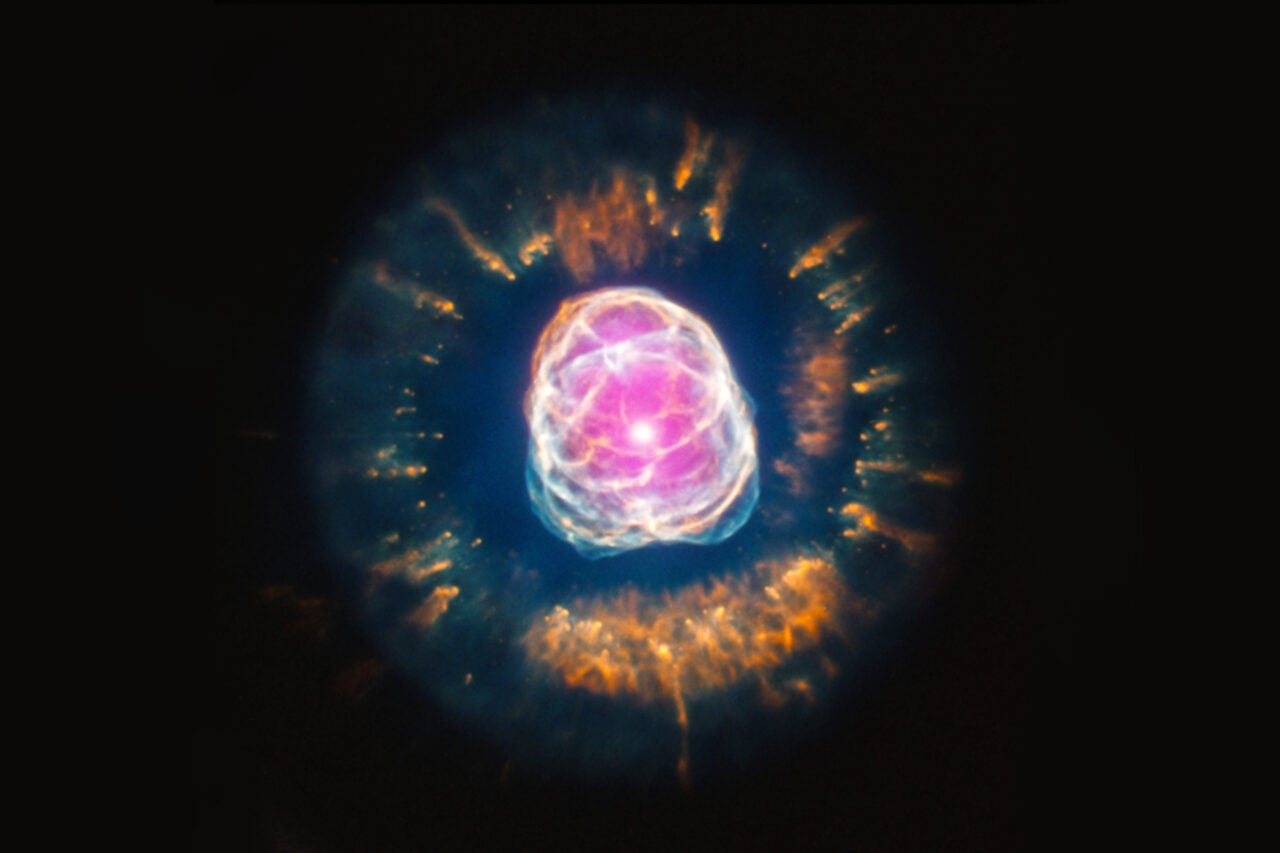
Astrophysicists from the University of British Columbia have proposed a new perspective on the behavior of white dwarfs, potentially connecting these stellar remnants to the elusive concept of dark matter through the study of axions. Although their findings, detailed in a preprint on arXiv, have yet to undergo peer review, the research presents intriguing possibilities for understanding the universe’s composition.
The concept of axions, first introduced in 1977, was initially aimed at resolving discrepancies between matter and antimatter in quantum physics. These hypothetical particles are considered a leading candidate for dark matter, which is believed to constitute approximately 85% of the universe. Dark matter is termed “dark” because it interacts minimally with visible matter, making its detection a significant challenge.
White dwarfs, the dense cores remaining after a star’s death, provide a unique environment for exploring these theoretical particles. Under typical conditions, these stars should collapse due to immense gravitational pressure. However, they resist this fate thanks to a phenomenon known as electron degeneracy pressure, which prevents electrons from occupying the same energy state. This results in electrons moving at high speeds, creating sufficient pressure to stabilize the white dwarf.
Researchers are particularly interested in the cooling rates of these stars, as some have been observed to cool much faster than anticipated. The team speculated that if white dwarfs were producing axions, the energy loss associated with these particles could explain the unexpected cooling.
To test their hypothesis, the researchers analyzed archival data from the Hubble Space Telescope and conducted simulations regarding the influence of axions on white dwarfs. They formulated predictions related to the temperature and age of these stars, comparing their results with actual data from 47 Tucanae, a globular cluster rich in white dwarfs.
Despite their comprehensive approach, the researchers did not find evidence supporting the cooling effect of axions. Nonetheless, they established a new limit on the likelihood of electrons producing axions—approximately once in a trillion attempts.
Astrophysicist Paul Sutter from Johns Hopkins University, who was not involved in the study, commented on the implications of the research. He noted that while the results do not eliminate the possibility of axions, they indicate that direct interactions between electrons and axions are unlikely. Sutter emphasized the need for innovative approaches in the ongoing search for these particles.
This ongoing exploration of axions and their potential connection to dark matter reflects the complex and often puzzling nature of astrophysics. As scientists continue to investigate the mysteries of the universe, even negative findings contribute to a deeper understanding of cosmic phenomena. The journey to uncover the nature of dark matter remains one of the most significant challenges in contemporary physics, with researchers like those at the University of British Columbia paving the way for future discoveries.











Revolutionary Photonic Ski-Jump Could Miniaturize LiDAR Systems

Couples Detox from Plastics in New Netflix Doc: Can It Boost Fertility?

Aventon Launches Affordable Full-Suspension Electric Mountain Bike

Discover Eight Must-Try Restaurants This Spring Season

UC Irvine Team Unveils Innovative Ion Pump for Water Treatment

One-Third of Americans Trim Daily Expenses for Healthcare Needs

Apple Secures First Oscar in Three Years with F1: The Movie

Fourth Graders Celebrate St. Patrick’s Day with Creative Weather Drawings

Kim Kardashian Dazzles at Vanity Fair Oscars Party 2026

Nostradamus’ 2026 Predictions: Star Death and Dark Events Loom

Breakthroughs and Challenges Await Science in 2026

Electric Moto Influencer Surronster Arrested in Tijuana

OpenAI to Implement Age Verification for ChatGPT by December 2025

Discover the Top 10 Calorie Counting Apps of 2025

Bella Hadid Shares Health Update After Treatment for Lyme Disease

Analysts Project Stronger Growth for Apple’s iPhone 17 Lineup

Japanese Study Finds Rose Oil Can Increase Brain Gray Matter

Top 10 Penny Stocks to Watch in 2026 for Strong Returns
-
 Science4 months ago
Nostradamus’ 2026 Predictions: Star Death and Dark Events Loom
-
 Science4 months ago
Breakthroughs and Challenges Await Science in 2026
-
 Technology7 months ago
Electric Moto Influencer Surronster Arrested in Tijuana
-
 Technology4 months ago
OpenAI to Implement Age Verification for ChatGPT by December 2025
-
 Technology9 months ago
Discover the Top 10 Calorie Counting Apps of 2025
-
 Health7 months ago
Bella Hadid Shares Health Update After Treatment for Lyme Disease
-
 Health7 months ago
Analysts Project Stronger Growth for Apple’s iPhone 17 Lineup
-
 Health7 months ago
Japanese Study Finds Rose Oil Can Increase Brain Gray Matter
-
 Technology4 months ago
Top 10 Penny Stocks to Watch in 2026 for Strong Returns
-

 Science6 months ago
Starship V3 Set for 2026 Launch After Successful Final Test of Version 2
-

 Technology1 month ago
Nvidia GTC 2026: Major Announcements Expected for AI and Hardware
-

 Education7 months ago
Harvard Secures Court Victory Over Federal Funding Cuts