
Education
Cornell Unveils Innovative Cake-Pan Telescope to Study Cosmic Bursts

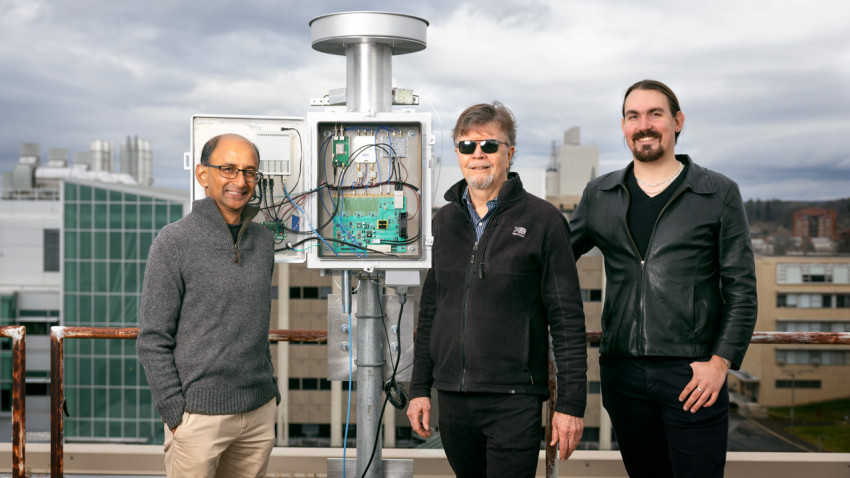
A pioneering telescope, built from cake pans, is set to revolutionize the search for fast radio bursts (FRBs) in the cosmos. Developed by a team at Cornell University in collaboration with the California Institute of Technology (Caltech), the Global Radio Explorer (GReX) aims to capture these elusive signals that occur daily across the sky for mere milliseconds.
The GReX project, which consists of eight terminals, is currently being constructed and tested at both Cornell and Caltech. Cornell’s terminal is situated on the roof of the Space Sciences Building. “It works and it’s cost-effective,” explained Sashabaw Niedbalski, a fifth-year doctoral candidate in astronomy. This innovative approach utilizes the geometry of concentric cake pans to create a horn-style feed antenna, which minimizes interference from human-made signals and allows the telescope to concentrate on the sky above.
Every day, approximately 10,000 fast radio bursts occur, akin to flash bulbs popping off. According to Shami Chatterjee, an associate professor of astronomy at Cornell, the challenge lies in capturing these fleeting signals: “Unless you’re looking at that patch of the sky at that specific millisecond, you’re never going to see it.” The GReX project aims to fill this observational gap by significantly expanding its field of view.
Once fully deployed, the GReX network will provide an instantaneous field of view over a substantial portion of the sky, with each station capable of observing 10% to 20% of the total expanse. The ultimate goal is to monitor the entire sky continuously. “There are no other radio telescope projects that I’m aware of doing that,” Niedbalski stated.
Bursts detected by GReX are anticipated to originate from various nearby galaxies as well as the Milky Way. This data will be instrumental in exploring local interstellar and intergalactic environments. James Cordes, the George Feldstein Professor of Astronomy, emphasized the potential of the gathered information: “It could provide clues into the environments of the bursts’ sources and how they were formed.”
GReX is built upon the foundation of a previous project at Caltech, called STARE2, which successfully detected an extraordinarily bright burst from a magnetar in the Milky Way. This achievement served as proof of concept for the GReX design. “We took the elements that worked well and transformed it from a single station located within the southwestern U.S. into an international project,” Niedbalski said.
The multilocation setup of GReX offers additional benefits. Different environments mean that signals caused by human activity or natural phenomena, such as lightning, will likely be detected by only one station. This capability allows researchers to triangulate the source of signals more accurately. Currently, instruments are operational at the Hat Creek Radio Observatory, the Owens Valley Radio Observatory in California, Harvard, and Ireland’s Birr Observatory. A sixth terminal in Australia is expected to become operational soon, with plans for future installations in Chile and the northeastern United States.
Data collection for GReX is substantial, at 8 gigabytes per second. Given the sheer volume of information, it is impractical to store all of it for later analysis. The team employs advanced digital backend electronics to manage this data flow, utilizing a 60-second buffer. This system allows the telescope to analyze incoming data for significant signals and retain relevant findings for further study.
The modular design of the telescope software facilitates easy upgrades, allowing components to be changed without affecting the entire system. While GReX was originally intended to discover radio bursts from known classes of astronomical objects, Cordes noted the possibility of uncovering unexpected sources: “When looking at the sky in a somewhat new way, we tend to find new things.”
As the GReX project progresses, it holds the promise of unveiling insights into the enigmatic fast radio bursts that continue to intrigue astronomers worldwide. With its innovative approach, this cake-pan telescope could redefine our understanding of the universe.











Discover Glass Art: Engaging Workshops at SiNaCa Studios

Explore Texas Craftsmanship at the 21st Grapevine Artisans Market

NASA Force Initiative Launches to Recruit Elite Tech Talent

Community Events Highlight Support Groups and Fundraisers

Genesis G90: A Luxurious Choice for Value-Conscious Buyers

Schools Tackle Chronic Absenteeism in Ashtabula County

Discover Lasting Love at the Becoming One Marriage Retreat

Study Unveils Inaccuracies of ‘Demon Slayer’ Bamboo Muzzle Design

Parents Voice Concerns Over Maine’s Proposed Changes to Child Services

Nostradamus’ 2026 Predictions: Star Death and Dark Events Loom

Breakthroughs and Challenges Await Science in 2026

OpenAI to Implement Age Verification for ChatGPT by December 2025

Discover the Top 10 Calorie Counting Apps of 2025

Electric Moto Influencer Surronster Arrested in Tijuana

Bella Hadid Shares Health Update After Treatment for Lyme Disease

Analysts Project Stronger Growth for Apple’s iPhone 17 Lineup

Top 10 Penny Stocks to Watch in 2026 for Strong Returns

Japanese Study Finds Rose Oil Can Increase Brain Gray Matter
-
 Science2 months ago
Nostradamus’ 2026 Predictions: Star Death and Dark Events Loom
-
 Science2 months ago
Breakthroughs and Challenges Await Science in 2026
-
 Technology3 months ago
OpenAI to Implement Age Verification for ChatGPT by December 2025
-
 Technology8 months ago
Discover the Top 10 Calorie Counting Apps of 2025
-
 Technology6 months ago
Electric Moto Influencer Surronster Arrested in Tijuana
-
 Health6 months ago
Bella Hadid Shares Health Update After Treatment for Lyme Disease
-
 Health6 months ago
Analysts Project Stronger Growth for Apple’s iPhone 17 Lineup
-
 Technology3 months ago
Top 10 Penny Stocks to Watch in 2026 for Strong Returns
-
 Health6 months ago
Japanese Study Finds Rose Oil Can Increase Brain Gray Matter
-

 Science5 months ago
Starship V3 Set for 2026 Launch After Successful Final Test of Version 2
-
 Education6 months ago
Harvard Secures Court Victory Over Federal Funding Cuts
-

 Health6 months ago
Erin Bates Shares Recovery Update Following Sepsis Complications