
Science
New Study Reveals Moonquake Risks Could Impact NASA’s Plans

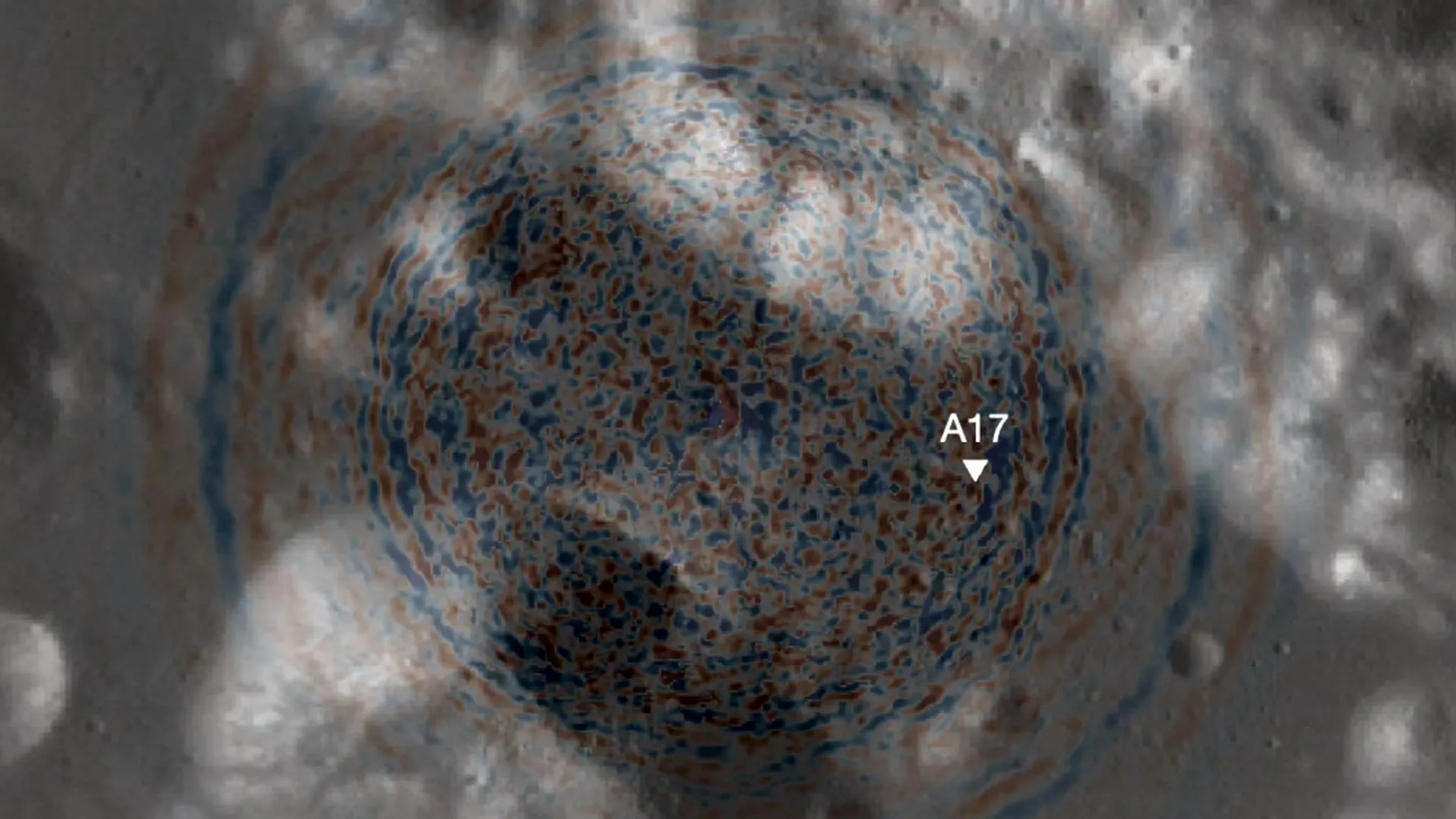
Recent research has unveiled significant findings regarding moonquakes, suggesting they are the primary cause of terrain shifts near the Apollo 17 landing site. This revelation, made by scientists from the University of Maryland, could have profound implications for NASA’s future lunar mission strategies.
The study, published on December 7, 2025, in the journal *Science Advances*, indicates that the shifting landscape in the Taurus-Littrow valley, where Apollo 17 astronauts landed in 1972, is not primarily due to meteoroid impacts, as previously thought. Instead, the analysis highlights the presence of an active fault that has been generating quakes for millions of years.
Understanding Moonquake Activity
The research team, comprising Smithsonian Senior Scientist Emeritus Thomas R. Watters and University of Maryland Associate Professor of Geology Nicholas Schmerr, examined geological evidence collected during the Apollo 17 mission. Astronauts had documented boulder tracks and landslides, which the researchers linked to seismic activity. By analyzing this data, they estimated the strength of past moonquakes and identified the fault responsible for these phenomena.
“We don’t have the sort of strong motion instruments that can measure seismic activity on the moon like we do on Earth,” Schmerr explained. “So we had to look for other ways to evaluate how much ground motion there may have been, like boulder falls and landslides that get mobilized by these seismic events.”
This study points to moonquakes with magnitudes near 3.0, which, while mild by Earth standards, can cause considerable disturbance when occurring close to their source. The researchers identified the Lee-Lincoln fault as a tectonic feature responsible for these quakes, suggesting that it remains active and has not yet gone dormant.
Implications for Future Lunar Missions
Watters and Schmerr assessed the risks associated with future lunar operations, estimating a one in 20 million chance of a damaging quake occurring on any given day near an active fault. While this may seem negligible, Schmerr emphasized the importance of considering such risks in long-term planning for lunar infrastructure.
“Everything in life is a calculated risk,” he noted. “The risk of something catastrophic happening isn’t zero. While it’s small, it’s not something you can completely ignore while planning long-term infrastructure on the lunar surface.”
Short-term missions, like Apollo 17, face minimal danger due to their brief duration. However, the potential risks increase significantly for longer missions, particularly as NASA advances its Artemis program, which aims to establish a continuous human presence on the moon. Upcoming missions using taller lander designs, such as the Starship Human Landing System, may be more vulnerable to ground acceleration caused by nearby moonquakes.
Schmerr elaborated on the implications of this increased risk for prolonged lunar habitation, likening the statistical chances to the difference between winning a lottery and drawing a winning poker hand.
The researchers advocate for a cautious approach to lunar construction, urging planners to avoid building directly on or near scarps and active faults. They recommend prioritizing the deployment of new seismic instruments to enhance understanding of lunar seismicity.
Supporting Research and Future Prospects
This study was supported by data from NASA’s Lunar Reconnaissance Orbiter mission, which has been instrumental in mapping the lunar surface since its launch on June 18, 2009. While this research sheds light on the potential dangers posed by moonquakes, it also contributes to the evolving field of lunar paleoseismology, which studies ancient seismic activity on the moon.
Schmerr anticipates that advancements in technology, including high-resolution mapping and new seismometers deployed during upcoming Artemis missions, will enhance understanding of lunar geology. “We want to ensure that our exploration of the moon is done safely and that investments are made in a way that’s carefully thought out,” he stated.
As NASA prepares for its future missions, these findings underscore the need to approach lunar exploration with an awareness of the unique challenges posed by the moon’s geological activity. The research provides crucial insights that could shape the planning and safety of future lunar bases, ensuring the sustainability of human presence on the moon.






Revolutionary Photonic Ski-Jump Could Miniaturize LiDAR Systems

Couples Detox from Plastics in New Netflix Doc: Can It Boost Fertility?

Aventon Launches Affordable Full-Suspension Electric Mountain Bike

Discover Eight Must-Try Restaurants This Spring Season

UC Irvine Team Unveils Innovative Ion Pump for Water Treatment

One-Third of Americans Trim Daily Expenses for Healthcare Needs

Apple Secures First Oscar in Three Years with F1: The Movie

Fourth Graders Celebrate St. Patrick’s Day with Creative Weather Drawings

Kim Kardashian Dazzles at Vanity Fair Oscars Party 2026

Nostradamus’ 2026 Predictions: Star Death and Dark Events Loom

Breakthroughs and Challenges Await Science in 2026

Electric Moto Influencer Surronster Arrested in Tijuana

OpenAI to Implement Age Verification for ChatGPT by December 2025

Discover the Top 10 Calorie Counting Apps of 2025

Bella Hadid Shares Health Update After Treatment for Lyme Disease

Analysts Project Stronger Growth for Apple’s iPhone 17 Lineup

Japanese Study Finds Rose Oil Can Increase Brain Gray Matter

Top 10 Penny Stocks to Watch in 2026 for Strong Returns
-
 Science3 months ago
Nostradamus’ 2026 Predictions: Star Death and Dark Events Loom
-
 Science4 months ago
Breakthroughs and Challenges Await Science in 2026
-
 Technology7 months ago
Electric Moto Influencer Surronster Arrested in Tijuana
-
 Technology4 months ago
OpenAI to Implement Age Verification for ChatGPT by December 2025
-
 Technology9 months ago
Discover the Top 10 Calorie Counting Apps of 2025
-
 Health7 months ago
Bella Hadid Shares Health Update After Treatment for Lyme Disease
-
 Health7 months ago
Analysts Project Stronger Growth for Apple’s iPhone 17 Lineup
-
 Health7 months ago
Japanese Study Finds Rose Oil Can Increase Brain Gray Matter
-
 Technology4 months ago
Top 10 Penny Stocks to Watch in 2026 for Strong Returns
-

 Science6 months ago
Starship V3 Set for 2026 Launch After Successful Final Test of Version 2
-

 Technology1 month ago
Nvidia GTC 2026: Major Announcements Expected for AI and Hardware
-

 Education7 months ago
Harvard Secures Court Victory Over Federal Funding Cuts