
Science
NASA’s Innovation: How Digital Twins Enhance Space Robotics

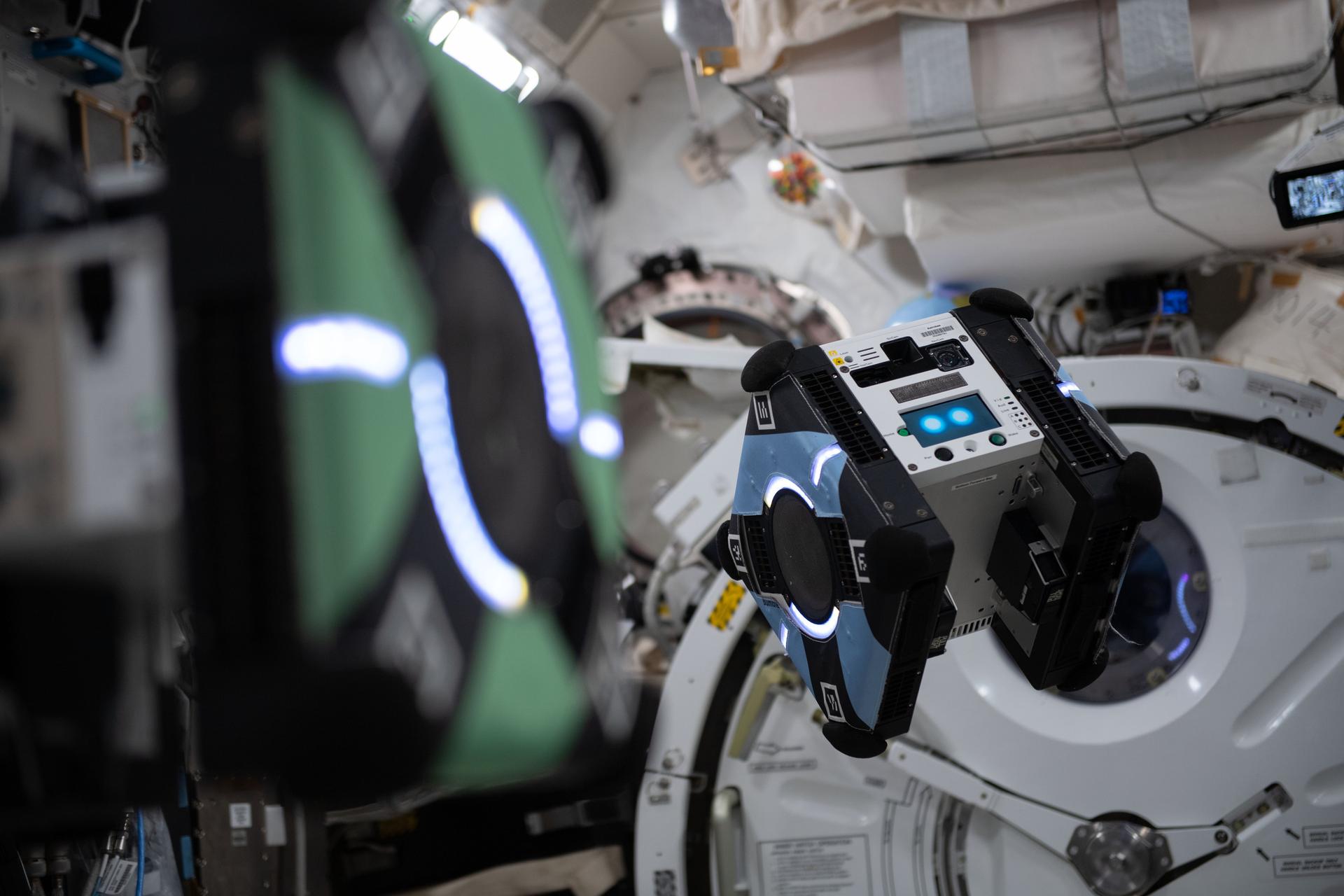
A new algorithm has significantly improved the navigation of autonomous robots aboard the International Space Station (ISS), thanks to a collaboration between NASA and Professor Pyojin Kim from the Gwangju Institute of Science and Technology (GIST). This advancement allows robots like Astrobee to operate without requiring astronaut intervention, thereby optimizing the crew’s time for scientific research.
Robots in space face unique challenges due to the absence of gravity. Unlike terrestrial robots that utilize Inertial Measurement Units (IMUs) to maintain orientation, space robots often become disoriented and drift. This complication can force astronauts to pause their critical work to recalibrate the machines. The new algorithm proposed by Professor Kim has reduced the average rotational error to just 1.43 degrees, allowing for a “drift-free” navigation capability.
Transforming Navigation Challenges into Solutions
Astrobee is designed to handle routine tasks on the ISS, freeing astronauts to focus on their research. Despite its advanced technology, the robot struggled to maintain its bearings in the cluttered environment of the ISS, which is filled with equipment and personal items that can obstruct its sensors. Professor Kim’s team recognized that traditional navigation algorithms developed for Earth could not be directly applied in space due to the lack of gravitational reference points.
The breakthrough came when the team developed a system using Visual-Based Navigation (VBN). This approach allows the robot to interpret its surroundings using camera data. However, the chaotic interior of the ISS presented significant challenges. “We thought we could apply Earth-based technology,” Professor Kim noted. “It did not perform reliably in the ISS environments.”
To overcome this limitation, the team created a digital twin, a precise 3D model of the ISS that eliminates clutter. This model serves as a baseline for the robot to cross-reference real-time images with a clean virtual environment, effectively filtering out distractions and recalibrating its position. By identifying structural features such as walls and floors, the robot can triangulate its position accurately.
The application of this technology has not only enhanced the performance of Astrobee but may also have broader implications for robotics on Earth. Professor Kim suggests that the methods developed for space could be beneficial for indoor drones and robots, particularly in environments where GPS is unavailable.
Broader Implications for Space Exploration
The collaborative effort between NASA and GIST underscores the evolving landscape of space exploration, where partnerships between public agencies and private enterprises are becoming increasingly vital. Professor Kim emphasizes the economic potential of space, stating, “Because space now holds real economic and industrial value, showing commercial potential.” With companies like SpaceX demonstrating that space can be a viable business frontier, an influx of startups is emerging to explore opportunities such as lunar mining and satellite assembly.
Professor Kim’s journey into this field began with an internship at NASA’s Ames Research Center, where he was involved in the development of Astrobee. His insights into the similarities between terrestrial drones and space robots have been instrumental in refining navigation technologies for both environments. He expressed gratitude for the opportunities provided by his mentors at NASA, which have been pivotal in his career.
NASA’s commitment to innovation extends beyond its technical achievements. The agency fosters a culture that encourages experimentation and learning from failures. As Professor Kim observed, “Behind every public triumph lie dozens of quiet failures.” This willingness to embrace setbacks is a cornerstone of NASA’s approach to research, allowing it to make significant strides in technology development.
As the landscape of space exploration continues to evolve, advancements like those achieved by Professor Kim and his team will play a crucial role in ensuring that robots can operate effectively in the challenging environments of space. The implications of this research extend far beyond the ISS, potentially transforming how robots navigate complex spaces on Earth and in future extraterrestrial missions.





Revolutionary Photonic Ski-Jump Could Miniaturize LiDAR Systems

Couples Detox from Plastics in New Netflix Doc: Can It Boost Fertility?

Aventon Launches Affordable Full-Suspension Electric Mountain Bike

Discover Eight Must-Try Restaurants This Spring Season

UC Irvine Team Unveils Innovative Ion Pump for Water Treatment

One-Third of Americans Trim Daily Expenses for Healthcare Needs

Apple Secures First Oscar in Three Years with F1: The Movie

Fourth Graders Celebrate St. Patrick’s Day with Creative Weather Drawings

Kim Kardashian Dazzles at Vanity Fair Oscars Party 2026

Nostradamus’ 2026 Predictions: Star Death and Dark Events Loom

Breakthroughs and Challenges Await Science in 2026

Electric Moto Influencer Surronster Arrested in Tijuana

OpenAI to Implement Age Verification for ChatGPT by December 2025

Discover the Top 10 Calorie Counting Apps of 2025

Bella Hadid Shares Health Update After Treatment for Lyme Disease

Analysts Project Stronger Growth for Apple’s iPhone 17 Lineup

Japanese Study Finds Rose Oil Can Increase Brain Gray Matter

Top 10 Penny Stocks to Watch in 2026 for Strong Returns
-
 Science3 months ago
Nostradamus’ 2026 Predictions: Star Death and Dark Events Loom
-
 Science4 months ago
Breakthroughs and Challenges Await Science in 2026
-
 Technology7 months ago
Electric Moto Influencer Surronster Arrested in Tijuana
-
 Technology4 months ago
OpenAI to Implement Age Verification for ChatGPT by December 2025
-
 Technology9 months ago
Discover the Top 10 Calorie Counting Apps of 2025
-
 Health7 months ago
Bella Hadid Shares Health Update After Treatment for Lyme Disease
-
 Health7 months ago
Analysts Project Stronger Growth for Apple’s iPhone 17 Lineup
-
 Health7 months ago
Japanese Study Finds Rose Oil Can Increase Brain Gray Matter
-
 Technology4 months ago
Top 10 Penny Stocks to Watch in 2026 for Strong Returns
-

 Science6 months ago
Starship V3 Set for 2026 Launch After Successful Final Test of Version 2
-
 Technology1 month ago
Nvidia GTC 2026: Major Announcements Expected for AI and Hardware
-

 Education7 months ago
Harvard Secures Court Victory Over Federal Funding Cuts