
Science
Discover Key Planetary Events in 2026: Dates and Highlights

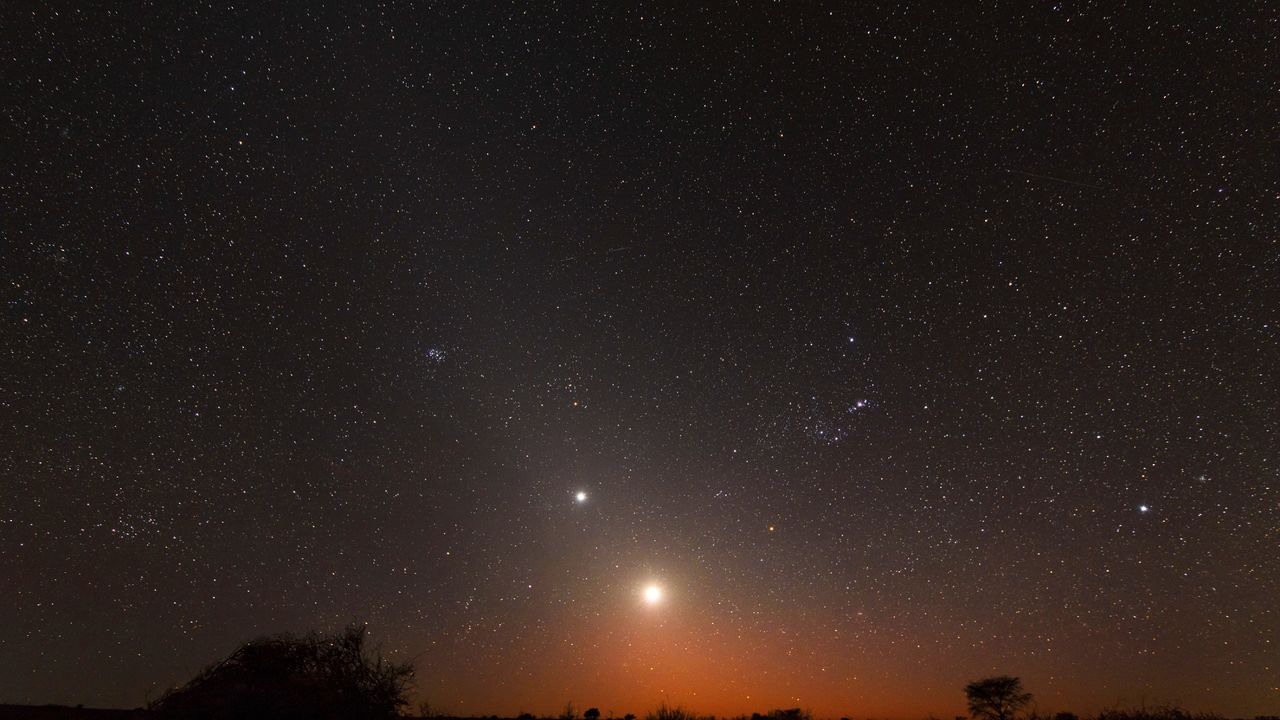
Astronomy enthusiasts can look forward to a thrilling year in 2026, filled with significant planetary events. From stunning conjunctions to periods of peak visibility, this guide outlines what to expect from each planet throughout the year. Key dates include important conjunctions and the best times to spot each celestial body.
Visibility Windows and Highlights
Mercury, the smallest planet visible to the naked eye, will appear as both an evening and morning star in 2026. To catch a glimpse, clear horizons are essential, as Mercury shines with a distinctive yellowish or ochre tint.
The visibility windows for Mercury in 2026 are as follows:
– Evenings: February 5–26; June 1–22; September 28–October 19
– Mornings: March 27–April 17; July 26–August 16; November 13–December 4
Notably, on the evening of February 18, Mercury will be just 1 degree above a slender waxing crescent moon shortly after sunset.
Venus will dominate the evening sky from March through October. This bright planet, nearly the same size as Earth, will reach its greatest brilliance on September 19 in the evening and on November 29 in the morning.
Key visibility dates include:
– Evenings: March 8–October 14
– Mornings: November 3–December 31
There are several notable conjunctions to watch for:
– March 8: Venus will be 1 degree above Saturn.
– June 9: Venus will appear 1.6 degrees above Jupiter, creating a breathtaking view shortly after sunset.
– November 7: Look for Venus, a crescent moon, and the star Spica within 2.5 degrees before sunrise.
Exploring Mars, Jupiter, and Beyond
Mars enters 2026 in the sun’s glare and reaches solar conjunction on January 9. It will gradually reappear in the early morning sky by late March, shining faintly among the stars of Aquarius.
Mars will be visible in the mornings from March 18 to December 31, with key highlights including:
– September 25: The stars Castor and Pollux will point directly towards Mars.
– November 26: Mars will pass 1.7 degrees above Regulus in Leo, showcasing a dramatic color contrast.
For those eager to see Jupiter, it will be particularly bright at opposition on January 10, shining at magnitude –2.7 in Gemini. Observers can witness a spectacular lunar occultation on October 6, when a waning crescent moon will obscure Jupiter for up to an hour across most of North America.
The visibility schedule for Jupiter is:
– Mornings: January 1–9; August 19–December 31
– Evenings: January 10–July 7
Saturn will enter opposition on October 4, providing excellent viewing opportunities. Its rings, which are gradually becoming more visible, will make it an exciting target. The visibility periods for Saturn are:
– Evenings: January 1–March 8; October 4–December 31
– Mornings: April 12–October 3
Notable conjunctions include:
– February 15: Saturn will sit less than 1 degree from Neptune, although Neptune is much fainter.
Uranus and Neptune will also be visible throughout 2026. Uranus will be in Taurus all year, with visibility in the evenings from January 1 to May 5 and November 25 to December 31. It reaches opposition on November 25. Neptune, remaining in Pisces, will not be visible without binoculars or a telescope, and it reaches opposition on September 25.
Joe Rao, an instructor and guest lecturer at New York’s Hayden Planetarium, notes that these celestial events offer excellent opportunities for sky watchers. With the right equipment and conditions, stargazers can enjoy the beauty and mystery of our solar system throughout 2026.









Scotland’s 13 Michelin Star Restaurants Gear Up for 2026 Guide

International Team Discovers New Dinosaur Foskeia pelendonum in Spain

Nebraska’s Miracle Quads Celebrate 18 Years of Joy

Stanford Daily Launches Volume 269 with New Editorial Team

Community Events Bring Art, Education, and Culture to Ulster County

Claws Out Comedy Open Mic Night Wins Best Comedy Night Accolade

NASA’s WB-57 Aircraft: A High-Altitude Research Powerhouse

AdventHealth’s Clinical Ladder Program Slashes Nurse Burnout

Washington Invests $12 Million to Expand EV Charging Network

Nostradamus’ 2026 Predictions: Star Death and Dark Events Loom

OpenAI to Implement Age Verification for ChatGPT by December 2025

Discover the Top 10 Calorie Counting Apps of 2025

Bella Hadid Shares Health Update After Treatment for Lyme Disease

Analysts Project Stronger Growth for Apple’s iPhone 17 Lineup

Electric Moto Influencer Surronster Arrested in Tijuana

Harvard Secures Court Victory Over Federal Funding Cuts

Erin Bates Shares Recovery Update Following Sepsis Complications

Meta Initiates $60B AI Data Center Expansion, Starting in Ohio
-
 Science1 month ago
Nostradamus’ 2026 Predictions: Star Death and Dark Events Loom
-
 Technology2 months ago
OpenAI to Implement Age Verification for ChatGPT by December 2025
-
 Technology7 months ago
Discover the Top 10 Calorie Counting Apps of 2025
-
 Health5 months ago
Bella Hadid Shares Health Update After Treatment for Lyme Disease
-
 Health5 months ago
Analysts Project Stronger Growth for Apple’s iPhone 17 Lineup
-
 Technology5 months ago
Electric Moto Influencer Surronster Arrested in Tijuana
-
 Education5 months ago
Harvard Secures Court Victory Over Federal Funding Cuts
-
 Health5 months ago
Erin Bates Shares Recovery Update Following Sepsis Complications
-
 Technology7 months ago
Meta Initiates $60B AI Data Center Expansion, Starting in Ohio
-

 Technology6 months ago
Discover How to Reverse Image Search Using ChatGPT Effortlessly
-

 Science4 months ago
Starship V3 Set for 2026 Launch After Successful Final Test of Version 2
-

 Technology7 months ago
Recovering a Suspended TikTok Account: A Step-by-Step Guide