
Science
Astronomers Unveil Largest Black Hole Jet, Transforming Galaxy Insights

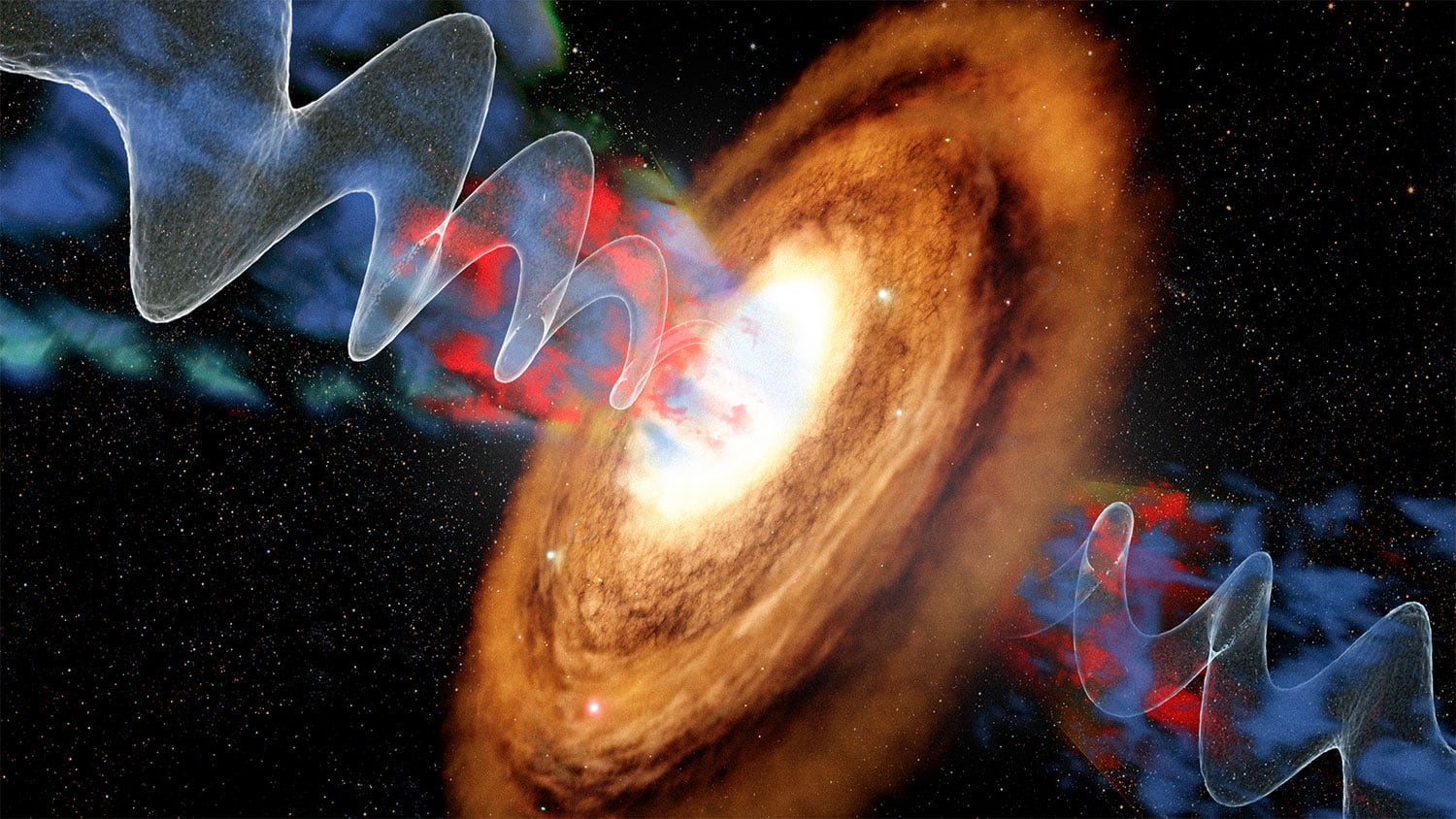
A team of astronomers has made a significant discovery regarding supermassive black holes (SMBHs) and their influence on galaxy evolution. Researchers from the University of California, Irvine and the Caltech Infrared Processing and Analysis Center uncovered the largest and most extensive jet ever observed in a nearby galaxy, revealing important implications for our understanding of galaxy formation and evolution.
During their investigation of the galaxy VV340a, conducted using the W. M. Keck Observatory located on Maunakea, Hawaiʻi, the team identified a jet extending up to 20,000 light-years from the galaxy’s core. Their findings, which were presented at the 247th Meeting of the American Astronomical Society in Phoenix, Arizona, are detailed in the journal Science.
Groundbreaking Observations from Multiple Telescopes
The research team utilized various advanced instruments, including the Keck Cosmic Web Imager (KCWI), the James Webb Space Telescope (JWST), and the Karl G. Jansky Very Large Array (VLA), to gather data about the galaxy’s structure and behavior. The KCWI allowed them to visualize a spear-like structure aligned with the galactic nucleus, while the infrared observations from JWST provided insights into the energetic core of VV340a.
According to Justin Kader, a UC Irvine postdoctoral researcher and lead author of the study, the combination of data from these observatories painted a comprehensive picture of the galaxy. Webb’s infrared data revealed the presence of “coronal” gas, a superheated plasma erupting from either side of the black hole, measuring several thousand parsecs across. This discovery marks the most extensive coronal gas structure ever documented, surpassing previous observations that typically measured in the hundreds of parsecs.
The VLA radio data further illustrated the dynamics of the galaxy, revealing a pair of plasma jets that exhibited a helical pattern as they propagated outward. This phenomenon, known as jet precession, indicates that the jets’ direction gradually wobbles over time.
Implications for Galaxy Evolution and Future Research
The study also highlighted that the jet is stripping gas from VV340a at a rate of about 20 solar masses per year, which could significantly influence star formation within the galaxy. Notably, the presence of these jets in a relatively young galaxy like VV340a, which is still undergoing a merger, challenges existing theories that typically link such jets to older elliptical galaxies that have ceased star formation.
“This discovery could reshape our understanding of the co-evolution of galaxies and their supermassive black holes,” Kader remarked. The implications of this finding extend to how we perceive the history and future of our own galaxy, the Milky Way.
Looking ahead, the research team plans to conduct higher-resolution radio observations to investigate the possibility of a second SMBH at the center of VV340a, which may be contributing to the observed wobbling of the jets. Vivian U, an associate scientist at Caltech/IPAC and senior author of the study, emphasized the potential for future discoveries, stating, “With Keck Observatory and these other powerful observatories working together, we’re opening a new window into how galaxies change over time.”
The collaboration among these institutions not only advances our understanding of black holes and galaxy evolution but also sets the stage for further exploration and discovery in the field of astrophysics.











Lightrun Launches AI Site Reliability Engineer for Real-Time Software Solutions

Connecticut College Students Call for More Visual Art Spaces

Hailey Bieber Stuns in Sommer Swim Bikini with Gold Accents

Antarctica’s Gravity Anomaly Sheds Light on Earth’s Interior Dynamics

Muscle Power Linked to Longevity: A New Health Insight

LightPath Technologies Outperforms Axion Power in Key Metrics

Dive into Self-Discovery with Proust on The Cosmic Library

Kendall Jenner Dazzles in Bold Crop Top for Vogue France

Avidity Biosciences Set to Release Q4 Earnings on February 26

Nostradamus’ 2026 Predictions: Star Death and Dark Events Loom

OpenAI to Implement Age Verification for ChatGPT by December 2025

Discover the Top 10 Calorie Counting Apps of 2025

Electric Moto Influencer Surronster Arrested in Tijuana

Bella Hadid Shares Health Update After Treatment for Lyme Disease

Breakthroughs and Challenges Await Science in 2026

Analysts Project Stronger Growth for Apple’s iPhone 17 Lineup

Top 10 Penny Stocks to Watch in 2026 for Strong Returns

Harvard Secures Court Victory Over Federal Funding Cuts
-
 Science2 months ago
Nostradamus’ 2026 Predictions: Star Death and Dark Events Loom
-
 Technology3 months ago
OpenAI to Implement Age Verification for ChatGPT by December 2025
-
 Technology7 months ago
Discover the Top 10 Calorie Counting Apps of 2025
-
 Technology5 months ago
Electric Moto Influencer Surronster Arrested in Tijuana
-
 Health5 months ago
Bella Hadid Shares Health Update After Treatment for Lyme Disease
-
 Science2 months ago
Breakthroughs and Challenges Await Science in 2026
-
 Health6 months ago
Analysts Project Stronger Growth for Apple’s iPhone 17 Lineup
-
 Technology2 months ago
Top 10 Penny Stocks to Watch in 2026 for Strong Returns
-
 Education6 months ago
Harvard Secures Court Victory Over Federal Funding Cuts
-

 Science4 months ago
Starship V3 Set for 2026 Launch After Successful Final Test of Version 2
-

 Health6 months ago
Erin Bates Shares Recovery Update Following Sepsis Complications
-

 Technology8 months ago
Meta Initiates $60B AI Data Center Expansion, Starting in Ohio