
Lifestyle
Scientist Explains Santa’s Global Journey Using Quantum Physics

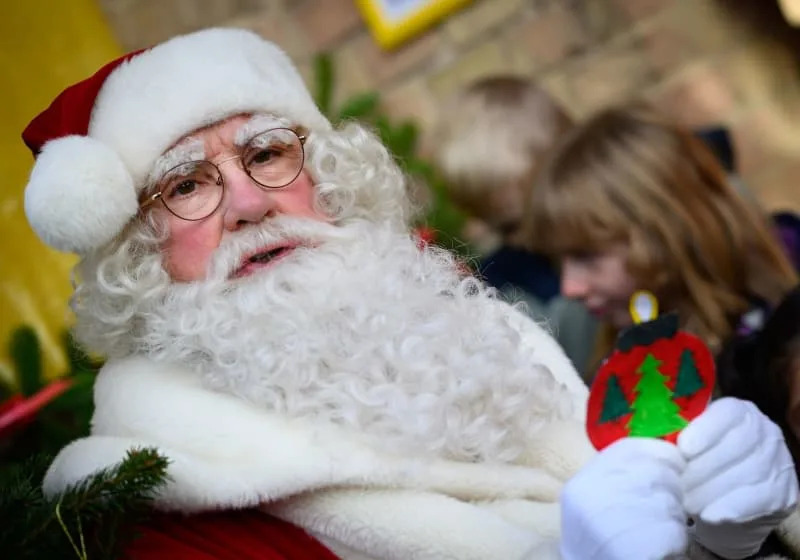
Every December 25, children around the world await the arrival of Santa Claus, who is said to deliver presents in a single night. While this festive tradition brings joy, it has also stirred scientific curiosity about its feasibility. Now, physicist Metin Tolan from Germany proposes that modern quantum physics could make Santa’s journey possible, as outlined in his book titled “Silent Night, Hasty Night.”
Tolan’s calculations assume Santa Claus exists, declaring that “the whole world simply cannot be wrong.” He references a famous moment from history when an eight-year-old girl, Virginia O’Hanlon, wrote to the New York Sun in 1897 asking if Santa was real. The newspaper’s response remains one of the most frequently reprinted articles, affirming the spirit of the holiday.
Historical Context and NORAD’s Role
Tolan also highlights a notable Christmas Eve incident from 1955, when a misdialed phone number led to the U.S. Air Force Colonel Harry Shoup answering questions from children who believed they were calling Santa. This event sparked the annual tradition of the North American Aerospace Defense Command (NORAD) tracking Santa’s journey, which can be followed at www.noradsanta.org.
The physics behind Santa’s annual race against time is staggering. Tolan estimates that Santa would need to visit about 234 million households in just 24 hours, requiring him to make approximately 2,708 visits per second. If he were to fly against the Earth’s rotation, he would have about 32 hours to complete his deliveries, reducing the required speed to about 2,000 visits per second. This speed exceeds the human eye’s maximum frame rate, making it impossible for anyone to witness Santa at work.
The Quantum Physics Explanation
To achieve this incredible feat, Tolan explains that Santa’s sleigh would need to travel a total distance of approximately 82 million kilometers while carrying a weight of over 200,000 tons. He calculates that to accelerate the sleigh to the necessary speed, Santa would require more energy than Germany consumes in an entire year.
Given these enormous challenges, Tolan introduces the concept of quantum theory. He posits that Santa could exist as a “matter wave,” allowing him to be present in multiple locations simultaneously. Tolan describes this Santa Claus wave as a superposition of all his possible states. According to quantum theory, Santa’s deliveries happen in such a way that they are never observed, preserving the magic of the holiday.
In Tolan’s view, Santa has been on his journey for an astonishing 20 octillion years—a figure that represents a 1 followed by 48 zeros. He concludes that while the insights offered in his book may not provide practical applications in daily life, they serve to enrich holiday conversations with fascinating scientific facts.
Ultimately, Tolan’s exploration of Santa Claus through the lens of quantum physics not only provides an entertaining perspective on a cherished tradition but also invites readers to reflect on the marvels of science in the context of festive celebrations.












Master Your Workouts: Prevent Overtraining for Better Results

Astronomers Capture Nearby Galaxy Cluster Merging Event

Salmonella Outbreak Linked to Raw Oysters Hospitalizes 20 Across 22 States

U.S. Chip Restrictions Propel China’s Tech Surge Amid Investor Shift

Tips to Prevent Overtraining and Enhance Your Workout Results

Drones Innovate Wildfire Detection and Suppression Techniques

Measles and Flu Cases Surge in the Carolinas: Urgent Health Alert

Internet Users Bypass Redactions in Epstein Files Release

Community Invited to Join Native Planting Day at Humboldt Coastal Nature Center

Discover the Top 10 Calorie Counting Apps of 2025

OpenAI to Implement Age Verification for ChatGPT by December 2025

Bella Hadid Shares Health Update After Treatment for Lyme Disease

Analysts Project Stronger Growth for Apple’s iPhone 17 Lineup

Erin Bates Shares Recovery Update Following Sepsis Complications

Discover How to Reverse Image Search Using ChatGPT Effortlessly

Electric Moto Influencer Surronster Arrested in Tijuana

Meta Initiates $60B AI Data Center Expansion, Starting in Ohio

Discover 2025’s Top GPUs for Exceptional 4K Gaming Performance
-
 Technology5 months ago
Discover the Top 10 Calorie Counting Apps of 2025
-
 Technology3 weeks ago
OpenAI to Implement Age Verification for ChatGPT by December 2025
-
 Health3 months ago
Bella Hadid Shares Health Update After Treatment for Lyme Disease
-
 Health4 months ago
Analysts Project Stronger Growth for Apple’s iPhone 17 Lineup
-
 Health4 months ago
Erin Bates Shares Recovery Update Following Sepsis Complications
-
 Technology5 months ago
Discover How to Reverse Image Search Using ChatGPT Effortlessly
-
 Technology3 months ago
Electric Moto Influencer Surronster Arrested in Tijuana
-
 Technology5 months ago
Meta Initiates $60B AI Data Center Expansion, Starting in Ohio
-
 Technology2 months ago
Discover 2025’s Top GPUs for Exceptional 4K Gaming Performance
-

 Technology5 months ago
Recovering a Suspended TikTok Account: A Step-by-Step Guide
-
 Health5 months ago
Tested: Rab Firewall Mountain Jacket Survives Harsh Conditions
-
 Lifestyle5 months ago
Belton Family Reunites After Daughter Survives Hill Country Floods