
Education
Lawmakers Push for Children’s Vision Bill to Enhance School Testing


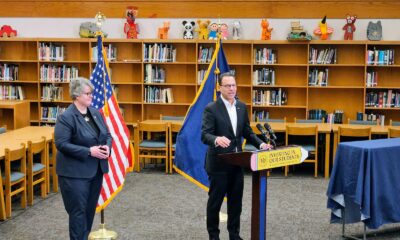
Efforts are underway in Pennsylvania to improve the vision health of students through the proposed Children’s Vision Bill. This legislation aims to mandate comprehensive eye examinations for students at critical educational milestones: kindergarten, fourth grade, and eighth grade. The bill, supported by bipartisan lawmakers including Sen. Chris Gebhard and Rep. Johanny Cepeda-Freytiz, seeks to address the significant issue of undiagnosed vision problems that hinder children’s academic performance.
Classrooms are bustling with activity as the school year progresses. However, many students face challenges stemming from poor vision that often goes undetected. Issues such as blurred words on pages and fading numbers on whiteboards can lead to feelings of frustration and confusion, inhibiting a child’s learning experience. According to Dr. Courtney McCall, an optometrist practicing in Pottsville and Hazleton, the consequences of unaddressed vision problems can be severe, resulting in lost confidence and declining grades.
Current school vision screenings, often conducted when children enter kindergarten, primarily focus on distance vision through basic tests like the familiar eye chart. These screenings are valuable but only scratch the surface of a child’s overall visual health. They typically fail to identify other significant conditions, such as amblyopia or subtle ocular misalignments, which can greatly affect learning, even when a child passes the standard test.
Reading, writing, and utilizing digital devices rely heavily on near vision and eye coordination. When these systems do not function properly, children might struggle with tasks like skipping lines while reading or experiencing frequent headaches. Such issues are subtle yet impactful, making it difficult for educators and parents to recognize the underlying problems.
A comprehensive eye exam includes a cycloplegic evaluation, which employs safe, temporary eye drops to relax the focusing system. This allows optometrists to determine a child’s true prescription, revealing issues that standard screenings might overlook. Many children adapt so effectively that they can mask significant focusing or alignment problems, making comprehensive eye exams essential for accurate diagnosis.
Research indicates a startling gap in the effectiveness of school screenings. The American Optometric Association reports that these tests miss up to 75 percent of children with treatable vision problems. This means that for every four students who struggle, three may never receive the necessary help.
The implications of undiagnosed vision problems extend beyond academics. Many students withdraw socially, developing negative beliefs about their abilities. Dr. McCall recounts a case of a child who faced significant challenges in school, struggling to recognize letters and shapes. After a thorough eye exam and subsequent prescription glasses, the child showed remarkable improvement in both academic performance and behavior, highlighting the transformative impact of addressing vision issues.
The proposed Children’s Vision Bill would require students to undergo evaluations by licensed optometrists or ophthalmologists, ensuring that vision-related challenges are identified early. Additionally, the bill stipulates that a comprehensive eye exam be performed before students receive an Individualized Education Plan (IEP) or similar support services. This measure would ensure that vision-related causes of learning difficulties are ruled out before labeling a child as needing special education support.
This initiative mirrors existing requirements for physical and dental examinations, presenting a straightforward, preventive measure with the potential to significantly enhance a child’s educational experience. Lawmakers have a unique opportunity to enact a policy that could drastically reduce the number of students who fall behind for preventable reasons.
Passing the Children’s Vision Bill would empower every child to fully engage with their education, enabling them to see the board, read their books, and explore their potential with clarity. The solution is straightforward; the benefits are profound. Ensuring that all students receive the eye care they need is a critical step toward fostering a brighter future for Pennsylvania’s youth.










DeKalb County’s CEO Implements Executive Order for Workforce Evolution

Google Unveils Revolutionary Image Editing Feature in Gemini

Lawmakers Push for Children’s Vision Bill to Enhance School Testing

Faith Community Church Hosts 20th Annual ‘Festividad for Christ’ Celebration

SpaceX Starlink Satellite Plummets After Anomaly in Orbit

DeKalb County CEO Implements New Work Structure Post-Pandemic

Research Reveals Why Some Brains Adapt Faster Than Others

Shnobel Tone Launches New Dumbbell Boost Pedal for Guitarists

Seniors Complete Police Academy, Strengthening Community Bonds

Discover the Top 10 Calorie Counting Apps of 2025

OpenAI to Implement Age Verification for ChatGPT by December 2025

Bella Hadid Shares Health Update After Treatment for Lyme Disease

Analysts Project Stronger Growth for Apple’s iPhone 17 Lineup

Erin Bates Shares Recovery Update Following Sepsis Complications

Discover How to Reverse Image Search Using ChatGPT Effortlessly

Electric Moto Influencer Surronster Arrested in Tijuana

Discover 2025’s Top GPUs for Exceptional 4K Gaming Performance

Meta Initiates $60B AI Data Center Expansion, Starting in Ohio
-
 Technology5 months ago
Discover the Top 10 Calorie Counting Apps of 2025
-
 Technology3 weeks ago
OpenAI to Implement Age Verification for ChatGPT by December 2025
-
 Health3 months ago
Bella Hadid Shares Health Update After Treatment for Lyme Disease
-
 Health3 months ago
Analysts Project Stronger Growth for Apple’s iPhone 17 Lineup
-
 Health3 months ago
Erin Bates Shares Recovery Update Following Sepsis Complications
-
 Technology5 months ago
Discover How to Reverse Image Search Using ChatGPT Effortlessly
-
 Technology3 months ago
Electric Moto Influencer Surronster Arrested in Tijuana
-
 Technology2 months ago
Discover 2025’s Top GPUs for Exceptional 4K Gaming Performance
-
 Technology5 months ago
Meta Initiates $60B AI Data Center Expansion, Starting in Ohio
-

 Technology5 months ago
Recovering a Suspended TikTok Account: A Step-by-Step Guide
-

 Health5 months ago
Tested: Rab Firewall Mountain Jacket Survives Harsh Conditions
-

 Lifestyle5 months ago
Belton Family Reunites After Daughter Survives Hill Country Floods