
Science
Researchers Unveil Origins of Hot Jupiters in New Study

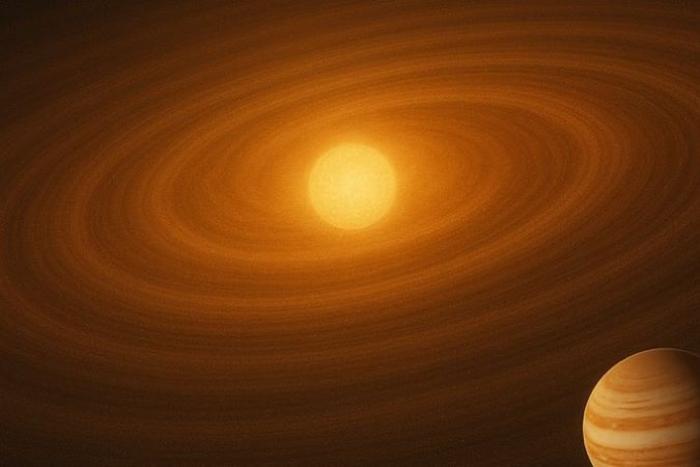
A recent study conducted by researchers from The University of Tokyo has shed light on the origins of hot Jupiters, gas giant exoplanets that orbit extremely close to their stars. Published in The Astronomical Journal, the research investigates the evolutionary paths of these fascinating celestial bodies, aiming to clarify how they ended up in their current orbits. The findings could significantly enhance our understanding of exoplanet formation and the implications for the search for extraterrestrial life.
The study focused on over 500 hot Jupiters, employing a series of mathematical equations to explore their orbital histories and migration processes. Two primary migration mechanisms were examined: disk migration and high-eccentricity migration (HEM). Disk migration occurs when a planet’s orbit shifts while still embedded in the protoplanetary disk surrounding its star, whereas HEM involves a planet’s orbit stretching into an elongated shape before settling into a circular form.
Researchers specifically analyzed the timescales for these orbital changes, comparing the transition from highly eccentric to circular orbits against the age of the planetary systems. The results indicated that most of the studied planets completed their orbital evolution in less time than their system’s age. However, approximately 30 hot Jupiters did not conform to this pattern, suggesting their migration timescales exceeded the age of their respective systems.
The team emphasized the necessity for further research, recommending a larger sample size to be examined. They also highlighted the importance of studying the obliquity, or tilt, of protoplanetary disks, as this factor may play a crucial role in disk migration dynamics. In addition, the researchers pointed out the potential of archival data from NASA’s Kepler telescope and the ongoing Transiting Exoplanet Survey Satellite (TESS) mission for advancing our understanding of hot Jupiter formation.
Hot Jupiters are particularly intriguing because they differ significantly from the gas giants in our solar system, such as Jupiter, which orbits much farther from the Sun. The first confirmed exoplanet, discovered in 1995, was a hot Jupiter, challenging existing theories about planetary system formation. Since then, scientists have verified the existence of approximately 500 to 600 hot Jupiters, accounting for roughly one-tenth of all confirmed exoplanets.
While the ratio of hot Jupiters to other exoplanets has decreased as discovery methods have advanced, the origins of these planets remain a topic of debate. Scientists continue to examine whether they formed in close proximity to their stars or migrated from more distant regions. Although the extreme temperatures of hot Jupiters and their potential moons render them inhospitable to life as we know it, they may provide valuable insights into planetary formation and evolution.
As research progresses, the scientific community eagerly anticipates new discoveries about hot Jupiters and their significance in the broader context of planetary science. The ongoing exploration of these enigmatic worlds promises to deepen our understanding of the universe and the processes that shape it.








Pediatrician Explains RSV: Symptoms, Risks, and Preventive Measures

BMW M2 Sets New Standard for Nighttime Driving Experience

New Hampshire Childcare Funding Faces Uncertainty Amid Federal Review

BMW M2 Redefines Night Driving with Innovative Cabin Lighting

Canadian Astronomers Unveil Milky Way’s Chaotic Origins Using JWST

Pediatrician Highlights Key Facts on RSV: Symptoms and Prevention

New Year, New Goals: Simple Exercises to Enhance Your Fitness

Utah Program Empowers Students Through Buddy Partnerships

Grab Up to 70% Off at Everlane’s Year-End Sale

Nostradamus’ 2026 Predictions: Star Death and Dark Events Loom

Discover the Top 10 Calorie Counting Apps of 2025

OpenAI to Implement Age Verification for ChatGPT by December 2025

Bella Hadid Shares Health Update After Treatment for Lyme Disease

Analysts Project Stronger Growth for Apple’s iPhone 17 Lineup

Erin Bates Shares Recovery Update Following Sepsis Complications

Electric Moto Influencer Surronster Arrested in Tijuana

Discover How to Reverse Image Search Using ChatGPT Effortlessly

Meta Initiates $60B AI Data Center Expansion, Starting in Ohio
-
 Science6 days ago
Nostradamus’ 2026 Predictions: Star Death and Dark Events Loom
-
 Technology6 months ago
Discover the Top 10 Calorie Counting Apps of 2025
-
 Technology1 month ago
OpenAI to Implement Age Verification for ChatGPT by December 2025
-
 Health4 months ago
Bella Hadid Shares Health Update After Treatment for Lyme Disease
-
 Health4 months ago
Analysts Project Stronger Growth for Apple’s iPhone 17 Lineup
-
 Health4 months ago
Erin Bates Shares Recovery Update Following Sepsis Complications
-
 Technology4 months ago
Electric Moto Influencer Surronster Arrested in Tijuana
-
 Technology5 months ago
Discover How to Reverse Image Search Using ChatGPT Effortlessly
-
 Technology6 months ago
Meta Initiates $60B AI Data Center Expansion, Starting in Ohio
-

 Technology6 months ago
Recovering a Suspended TikTok Account: A Step-by-Step Guide
-

 Technology2 months ago
Discover 2025’s Top GPUs for Exceptional 4K Gaming Performance
-

 Health5 months ago
Tested: Rab Firewall Mountain Jacket Survives Harsh Conditions