
Science
Researchers Unveil New Algorithm to Tackle Space Debris Threats

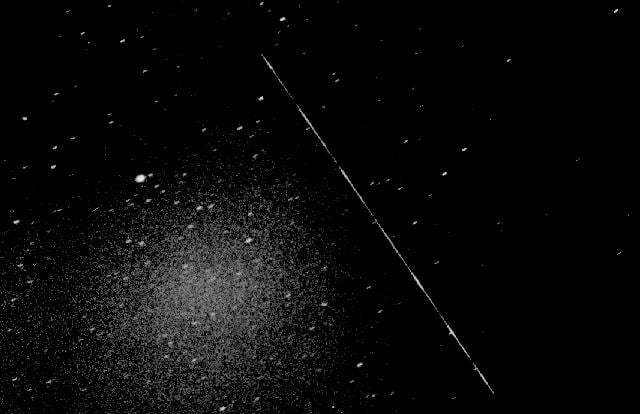
The growing problem of space debris poses a significant threat to operational satellites, with tens of thousands of pieces already in orbit. Researchers at GMV, a leading company in the orbital tracking sector in Europe, have developed a new algorithm called AISwarm-UKF to better understand the movement of this debris before engaging in removal efforts. This advancement is crucial in preventing potential incidents related to Kessler Syndrome, where collisions create more debris and exacerbate the issue.
Understanding how debris behaves in space is essential for devising effective removal strategies. A failure to accurately assess these movements could lead to operational satellites inadvertently contributing to the problem. The AISwarm-UKF algorithm leverages ground-based telescopes to study the light curves of debris, which are plots that show how the brightness of an object changes over time.
Innovative Approach Using Light Curves
In traditional astronomy, light curves help track phenomena such as star activity or the transit of exoplanets. In this context, as a piece of debris tumbles, its varying surfaces reflect sunlight differently. For instance, solar panels reflect less light compared to shiny metallic components. By analyzing the changes in brightness, researchers can deduce the object’s rotation speed and direction.
The challenge lies in resolving the “tumbling” behavior of these objects, as ground-based telescopes typically capture only a single pixel of larger debris. This limitation necessitates sophisticated mathematical techniques to interpret the data accurately. The light curve transforms this assessment into an inverse problem, a mathematical formulation that has applications across various fields, including robotics and food production.
Several factors complicate this analysis. Minor changes in a satellite’s angle can lead to significant fluctuations in the light curve, creating misleading data. Furthermore, certain orientations can produce similar light curves, making it difficult to distinguish between them. Additionally, conventional methods, such as the Unscented Kalman Filter (UKF), require a precise initial guess of the satellite’s orientation, within 5 degrees, for successful operation.
A Five-Step Pipeline for Accurate Estimation
To address these challenges, the GMV team designed a five-step pipeline within the AISwarm-UKF algorithm. The process starts by generating thousands of potential orientations—referred to as “particles”—using Bayesian inference to identify the most plausible matches against the observed light curve.
The next step involves “Systematic Resampling,” which enhances computational efficiency by duplicating high-probability particles and discarding those with lower probabilities. This method allows the algorithm to focus on more likely scenarios.
The third step employs Particle Swarm Optimization, directing the particles toward the optimal solution by minimizing the error in the inverse function. This is similar to finding the lowest point on a ski slope, where the algorithm must avoid local minima traps that could mislead it into identifying incorrect solutions.
Subsequent steps involve clustering the particles using a method known as Density-Based Spatial Clustering. This technique groups similar solutions, helping to narrow down the potential orientations of the satellite. The final stage applies the Kalman filter, utilizing these clusters to refine the solution, even when multiple correct answers may exist.
To validate the effectiveness of AISwarm-UKF, the researchers conducted experiments using a simulated satellite, generating artificial light curves through a tool called Grail. Notably, employing stereoscopic vision—gathering light curves from two different telescopes—reduced ambiguity in identifying the satellite’s orientation.
As space debris continues to threaten the functionality of existing satellites, tools like AISwarm-UKF will become increasingly vital. GMV plans to incorporate this algorithm into software packages for clients, including the German Space Situational Awareness Center and the Spanish Space Agency. With the stakes high, enhancing our understanding and management of space debris is essential for the future of satellite operations.












Senate to Vote on Competing Health Plans Impacting Millions

Disney Commits $1 Billion to OpenAI for Iconic Character Integration

Lawrence Kasdan’s Archive Opens Doors to ‘Star Wars’ Legends

Hillcrest Offers Essential Tips for Seniors’ Holiday Engagement

Lawrence Kasdan’s Archive Opens at University of Michigan

Senate Prepares to Vote on Competing Health Bills Impacting Costs

Discover the Eyelash Growth Serum Transforming Beauty Routines

Google Transforms Chrome with Advanced AI Features for Users

Custodian Witnesses Daughter Teach at School He Serves

Discover the Top 10 Calorie Counting Apps of 2025

Bella Hadid Shares Health Update After Treatment for Lyme Disease

OpenAI to Implement Age Verification for ChatGPT by December 2025

Erin Bates Shares Recovery Update Following Sepsis Complications

Discover How to Reverse Image Search Using ChatGPT Effortlessly

Analysts Project Stronger Growth for Apple’s iPhone 17 Lineup

Electric Moto Influencer Surronster Arrested in Tijuana

Discover 2025’s Top GPUs for Exceptional 4K Gaming Performance

Meta Initiates $60B AI Data Center Expansion, Starting in Ohio
-
 Technology5 months ago
Discover the Top 10 Calorie Counting Apps of 2025
-
 Health3 months ago
Bella Hadid Shares Health Update After Treatment for Lyme Disease
-
 Technology1 week ago
OpenAI to Implement Age Verification for ChatGPT by December 2025
-
 Health3 months ago
Erin Bates Shares Recovery Update Following Sepsis Complications
-
 Technology4 months ago
Discover How to Reverse Image Search Using ChatGPT Effortlessly
-
 Health3 months ago
Analysts Project Stronger Growth for Apple’s iPhone 17 Lineup
-
 Technology3 months ago
Electric Moto Influencer Surronster Arrested in Tijuana
-
 Technology1 month ago
Discover 2025’s Top GPUs for Exceptional 4K Gaming Performance
-
 Technology5 months ago
Meta Initiates $60B AI Data Center Expansion, Starting in Ohio
-

 Technology5 months ago
Recovering a Suspended TikTok Account: A Step-by-Step Guide
-

 Health5 months ago
Tested: Rab Firewall Mountain Jacket Survives Harsh Conditions
-

 Lifestyle5 months ago
Belton Family Reunites After Daughter Survives Hill Country Floods