
Science
Researchers Unveil Method for Lifelong Protein Control in Animals

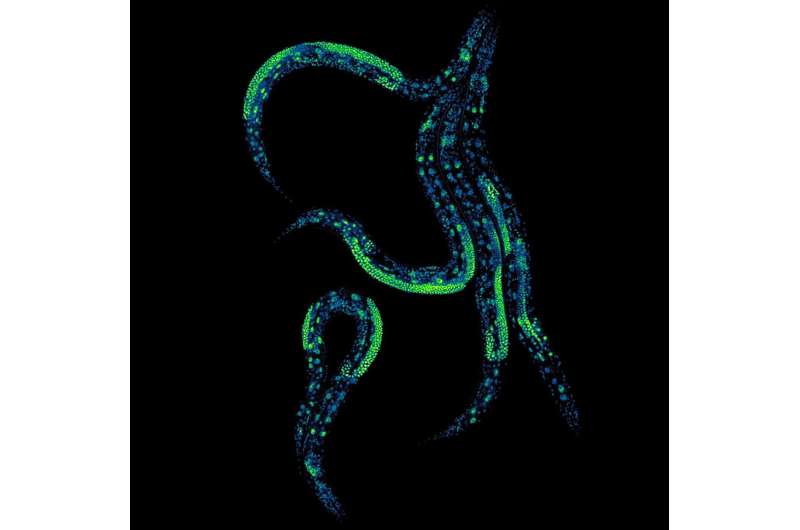
Researchers have achieved a significant breakthrough by enabling the precise control of protein levels in living animals throughout their lives. This innovative method, developed by scientists at the Center for Genomic Regulation in Barcelona and the University of Cambridge, allows for the manipulation of protein concentrations in various tissues of the model organism, the nematode worm Caenorhabditis elegans. The findings were published on December 12, 2025, in the journal Nature Communications.
This new technique offers scientists the ability to regulate protein levels with remarkable accuracy, which is crucial for investigating the biological mechanisms associated with aging and various diseases. The research team successfully demonstrated the method’s effectiveness by controlling protein amounts in the intestines and neurons of the worms.
Advancing Understanding of Aging and Disease
The implications of this research extend far beyond the laboratory. The ability to manipulate protein levels could lead to groundbreaking experiments that were previously unfeasible. For instance, researchers can now explore how varying amounts of a specific protein influence overall health. Dr. Nicholas Stroustrup, a researcher at the Center for Genomic Regulation and senior author of the study, noted, “No protein acts alone. Our new approach lets us study how multiple proteins in different tissues cooperate to control how the body functions and ages.”
Understanding systemic processes like aging requires a nuanced approach, as interactions between different organs play a critical role. Traditional experimental methods struggle to isolate the effects of proteins across various body parts. This new technique allows for a more precise, lifelong control of protein levels, shedding light on how subtle changes can impact the organism as a whole.
How the Dual-Channel AID System Works
The technique is an evolution of earlier methods drawn from plant biology, specifically the use of the hormone auxin for growth regulation. The research team adapted the auxin-inducible degron (AID) system, which tags proteins for degradation in the presence of auxin. Upon removing the hormone, the protein reappears.
By engineering different versions of the TIR1 enzyme and degrons, the researchers created a “dual-channel” AID system. This allows for fine-tuned control over protein levels in different tissues while the organism continues its normal activities. Dr. Stroustrup explained, “To unpick nuance in biology, sometimes you need half the concentration of a protein here and a quarter there. We wanted to be able to control proteins like you turn the volume up or down on a TV.”
Their innovative approach involves attaching a degron tag to the target protein and genetically modifying the worms to produce the TIR1 enzyme in specific tissues. When the worms consume food containing auxin, the plant hormone activates TIR1, which selectively removes the desired amount of the tagged protein.
The researchers also tackled a significant challenge: AID systems often fail in reproductive tissues. They adapted their system to overcome this limitation, ensuring functionality across the entire organism, including reproductive cells.
Dr. Jeremy Vicencio, a postdoctoral researcher at the Center for Genomic Regulation and co-author of the study, described the engineering process as complex. “Getting this to work was quite an engineering challenge. We had to test different combinations of synthetic switches to find the perfect pair that didn’t interfere with one another. Now that we’ve cracked it, we can control two separate proteins simultaneously with incredible precision.”
This advancement not only enhances the toolkit available to biologists but also opens new avenues for research into the intricate workings of life. The ability to manipulate proteins at will could lead to important discoveries in understanding health, disease, and the fundamental processes of aging.
Further information about this study can be found in Nature Communications, DOI: 10.1038/s41467-025-66347-x.






Revolutionary Photonic Ski-Jump Could Miniaturize LiDAR Systems

Couples Detox from Plastics in New Netflix Doc: Can It Boost Fertility?

Aventon Launches Affordable Full-Suspension Electric Mountain Bike

Discover Eight Must-Try Restaurants This Spring Season

UC Irvine Team Unveils Innovative Ion Pump for Water Treatment

One-Third of Americans Trim Daily Expenses for Healthcare Needs

Apple Secures First Oscar in Three Years with F1: The Movie

Fourth Graders Celebrate St. Patrick’s Day with Creative Weather Drawings

Kim Kardashian Dazzles at Vanity Fair Oscars Party 2026

Nostradamus’ 2026 Predictions: Star Death and Dark Events Loom

Breakthroughs and Challenges Await Science in 2026

Electric Moto Influencer Surronster Arrested in Tijuana

OpenAI to Implement Age Verification for ChatGPT by December 2025

Discover the Top 10 Calorie Counting Apps of 2025

Bella Hadid Shares Health Update After Treatment for Lyme Disease

Analysts Project Stronger Growth for Apple’s iPhone 17 Lineup

Japanese Study Finds Rose Oil Can Increase Brain Gray Matter

Top 10 Penny Stocks to Watch in 2026 for Strong Returns
-
 Science3 months ago
Nostradamus’ 2026 Predictions: Star Death and Dark Events Loom
-
 Science4 months ago
Breakthroughs and Challenges Await Science in 2026
-
 Technology7 months ago
Electric Moto Influencer Surronster Arrested in Tijuana
-
 Technology4 months ago
OpenAI to Implement Age Verification for ChatGPT by December 2025
-
 Technology9 months ago
Discover the Top 10 Calorie Counting Apps of 2025
-
 Health7 months ago
Bella Hadid Shares Health Update After Treatment for Lyme Disease
-
 Health7 months ago
Analysts Project Stronger Growth for Apple’s iPhone 17 Lineup
-
 Health7 months ago
Japanese Study Finds Rose Oil Can Increase Brain Gray Matter
-
 Technology4 months ago
Top 10 Penny Stocks to Watch in 2026 for Strong Returns
-

 Science6 months ago
Starship V3 Set for 2026 Launch After Successful Final Test of Version 2
-

 Technology1 month ago
Nvidia GTC 2026: Major Announcements Expected for AI and Hardware
-

 Education7 months ago
Harvard Secures Court Victory Over Federal Funding Cuts