
Science
NASA’s Artemis II Mission Set for Historic Lunar Journey

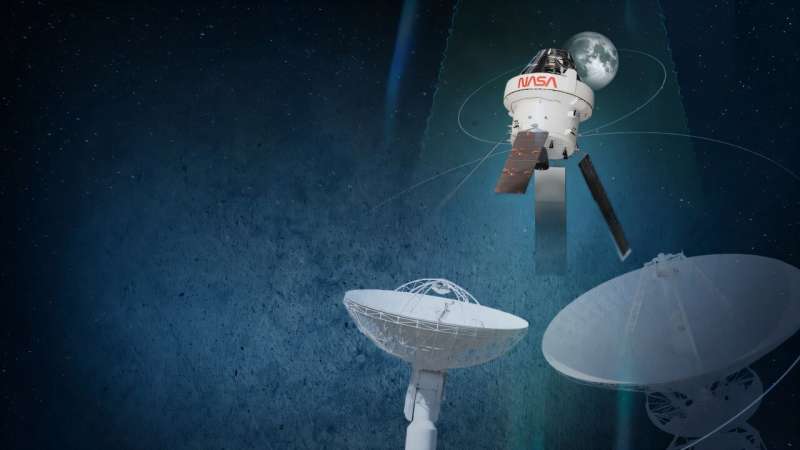
NASA’s Artemis II mission is poised to transport four astronauts around the moon, marking a significant step towards sending humans to Mars. Scheduled for launch, this mission will rely on advanced communication systems to maintain a connection throughout its journey. Signals will traverse thousands of miles as NASA’s networks facilitate the vital exchange of data, images, and voice communications between the crew and mission control.
To ensure seamless communication during Artemis II, NASA employs the Near Space Network and the Deep Space Network, both overseen by the agency’s Space Communications and Navigation (SCaN) Program office. These networks leverage global infrastructure and relay satellites to track the Orion spacecraft as it launches, orbits Earth, travels to the moon, and returns.
Ken Bowersox, associate administrator for NASA’s Space Operations Mission Directorate, emphasized the importance of robust space communications. “They’re the essential link that unites the crew and the exploration team on Earth to ensure safety and mission success,” he stated. Bowersox, who has firsthand experience aboard the International Space Station, noted that from real-time conversations with mission controllers to data that drives critical decisions, effective communication is vital for astronauts and mission managers alike.
Operational Coordination for Artemis II
NASA’s Mission Control Center at the Johnson Space Center in Houston will track the Space Launch System rocket, Interim Cryogenic Propulsion Stage, and Orion spacecraft through coordinated handoffs between multiple network assets. The Near Space Network will provide communication services during various mission stages using ground stations worldwide and a fleet of relay satellites.
After Orion’s translunar injection burn, which places the spacecraft on its trajectory around the moon, the Deep Space Network will take over primary communications support. This network, managed by NASA’s Jet Propulsion Laboratory in Southern California, consists of a global array of large radio antennas located in California, Spain, and Australia, ensuring a near-continuous connection with the Orion crew.
Kevin Coggins, deputy associate administrator for the SCaN Program, reiterated that “reliable communications are the lifeline of human spaceflight.” He noted that NASA’s partnerships with commercial entities significantly enhance space communication capabilities, setting the foundation for future exploration missions.
In addition to traditional radio communication, Artemis II will feature the Orion Artemis II Optical Communications System. This laser communications terminal is designed to transmit data over laser links, demonstrating that laser systems can transmit more than 100 times the data of traditional radio systems, even at vast distances from Earth.
Future Innovations and Challenges
While the Orion Artemis II Optical Communications System will not be part of the Artemis III mission, its development is a crucial step toward future advancements in lunar and deep space communications. The mission will also encounter a planned communications blackout lasting approximately 41 minutes as the spacecraft passes behind the moon, temporarily obstructing radio signals. Such blackouts are expected and were also a feature of earlier Apollo missions.
Following the blackout, the Deep Space Network will quickly reacquire Orion’s signal to restore communication with mission control. Each Artemis mission aims to enhance existing capabilities, including data processing methods. For Artemis II, data from Orion will be compressed upon returning to Earth to manage the large volumes of information generated, prioritizing crew communications and essential mission data.
Looking ahead, NASA’s Lunar Communications Relay and Navigation Systems project is collaborating with industry partners to eliminate communication blackouts and support precise navigation by deploying relay satellites around the moon. In 2024, NASA selected Intuitive Machines to develop the initial set of lunar relays for demonstration during the Artemis III lunar surface mission.
From liftoff to splashdown, NASA’s evolving communication networks are set to ensure that humanity’s return to the moon remains connected every step of the way. As the Artemis program progresses, these advancements promise to enhance the safety and success of future deep space missions.











Discover the Affordable Milani Skin Tint Stick Taking Over Drugstores

Toyota Issues Recall Due to Incorrect Taillights in bZ4X Models

Buffalo Schools Shift to Virtual Learning on Snow Days

Uggs Make a Bold Comeback on the Runway at Copenhagen Fashion Week

Fungi Thrive After Wildfires: UC Riverside Research Uncovers Secrets

Teddi Mellencamp Clarifies Cancer Status After Father’s Concern

Chester Upland Teachers Secure Five-Year Contract for Stability

My Sister’s Granola Raises Funds for SPCA of Luzerne County

Researchers Identify Early Parkinson’s Disease Biomarkers in Blood

Nostradamus’ 2026 Predictions: Star Death and Dark Events Loom

OpenAI to Implement Age Verification for ChatGPT by December 2025

Discover the Top 10 Calorie Counting Apps of 2025

Bella Hadid Shares Health Update After Treatment for Lyme Disease

Analysts Project Stronger Growth for Apple’s iPhone 17 Lineup

Electric Moto Influencer Surronster Arrested in Tijuana

Harvard Secures Court Victory Over Federal Funding Cuts

Erin Bates Shares Recovery Update Following Sepsis Complications

Discover How to Reverse Image Search Using ChatGPT Effortlessly
-
 Science1 month ago
Nostradamus’ 2026 Predictions: Star Death and Dark Events Loom
-
 Technology2 months ago
OpenAI to Implement Age Verification for ChatGPT by December 2025
-
 Technology6 months ago
Discover the Top 10 Calorie Counting Apps of 2025
-
 Health4 months ago
Bella Hadid Shares Health Update After Treatment for Lyme Disease
-
 Health5 months ago
Analysts Project Stronger Growth for Apple’s iPhone 17 Lineup
-
 Technology4 months ago
Electric Moto Influencer Surronster Arrested in Tijuana
-
 Education5 months ago
Harvard Secures Court Victory Over Federal Funding Cuts
-
 Health5 months ago
Erin Bates Shares Recovery Update Following Sepsis Complications
-
 Technology6 months ago
Discover How to Reverse Image Search Using ChatGPT Effortlessly
-

 Technology7 months ago
Meta Initiates $60B AI Data Center Expansion, Starting in Ohio
-

 Technology7 months ago
Recovering a Suspended TikTok Account: A Step-by-Step Guide
-

 Science3 months ago
Starship V3 Set for 2026 Launch After Successful Final Test of Version 2