
Science
NASA Reveals New Insights from Interstellar Comet 3I/ATLAS

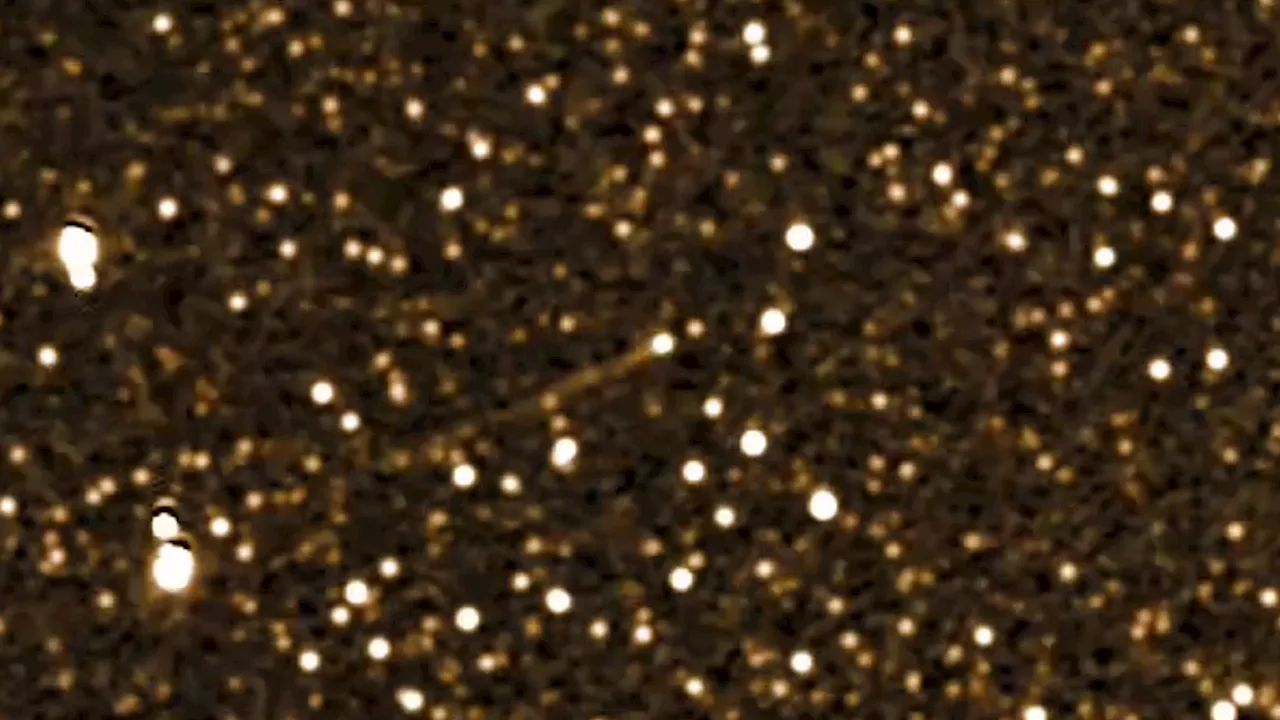
NASA has released a remarkable new set of images of interstellar comet 3I/ATLAS, providing groundbreaking insights into the comet’s journey through the solar system. These images, captured by various spacecraft, reveal details about the comet’s behavior and its interaction with the solar wind, offering a unique perspective on cometary science.
The comet was first identified by Ukrainian amateur astronomer Vladimir Bezugly while examining publicly available images from the Solar and Heliospheric Observatory (SOHO). Since its discovery, 3I/ATLAS has reached perihelion, its closest approach to the sun, at a distance of approximately 46.74 million miles. Early images showcased its striking bluish-green coma, formed as the sun’s heat vaporizes ice, releasing gas and dust that create its notable tail.
Significance of the Observations
The recent observations are particularly significant due to the advanced imaging technology employed. Continuous monitoring of a comet over time is unprecedented, allowing researchers to study its evolution and its interaction with the solar wind in much greater detail than ever before. According to NASA, this continuous observation provides valuable data for understanding the dynamics of space weather and its implications for both astronauts and technology on Earth.
As the comet traversed the solar system, its coma exhibited an unusual triangular shape, a phenomenon often linked to a fragmenting nucleus. This study also coincided with the presence of another comet, C/2025 R2 (SWAN), allowing scientists to analyze how both comets interacted with the solar wind. The findings are crucial for expanding our knowledge of cometary phenomena.
Images from the PUNCH spacecraft illustrated the comet gliding between two prominent celestial bodies, Mars above and the star Spica in the constellation Virgo below. These observations serve as a natural tracer of the solar wind, which consists of charged particles emanating from the sun and shaping the space environment throughout the solar system.
Implications for Future Research
NASA utilized multiple instruments and vantage points to track the comet, aiming to develop a comprehensive understanding of the space environment. The ability to observe 3I/ATLAS from various perspectives is essential for creating a complete picture of how solar phenomena affect celestial bodies.
The comet’s closest approach to Earth occurred in late October 2023, bringing it within approximately 25.10 million miles. This proximity provided an invaluable opportunity for in-depth studies, which are vital for scientists seeking to understand the composition of comets and their journeys through interstellar space. Research into such comets could illuminate the early solar system and the origins of life on Earth.
The detailed data captured from 3I/ATLAS not only enhances our understanding of comets but also contributes to ongoing efforts to analyze the broader implications of space weather. As technology continues to advance, such insights are crucial for preparing for future missions and safeguarding our infrastructure on Earth.





UCLA Students Drive Global Change Through Engineering Projects

Grab Bose QuietComfort Headphones at Record Low Price Today

NASA Reveals New Insights from Interstellar Comet 3I/ATLAS

French Study Confirms mRNA Vaccine Effectiveness Against Severe COVID

Netflix Seals $72 Billion Deal to Acquire Warner Bros. Assets

UCLA Engineers Impact Global Communities Through Innovative Projects

Join Statesville Police in Toy Drive at Walmart on December 6

Alkaline Microbes Pave Way for Safer Nuclear Waste Management

Call for Urgent Reform of Pharmacy Benefit Managers to Lower Drug Costs

Discover the Top 10 Calorie Counting Apps of 2025

Bella Hadid Shares Health Update After Treatment for Lyme Disease

Erin Bates Shares Recovery Update Following Sepsis Complications

Discover How to Reverse Image Search Using ChatGPT Effortlessly

Discover 2025’s Top GPUs for Exceptional 4K Gaming Performance

Electric Moto Influencer Surronster Arrested in Tijuana

Meta Initiates $60B AI Data Center Expansion, Starting in Ohio

Recovering a Suspended TikTok Account: A Step-by-Step Guide

Tested: Rab Firewall Mountain Jacket Survives Harsh Conditions
-
 Technology5 months ago
Discover the Top 10 Calorie Counting Apps of 2025
-
 Health3 months ago
Bella Hadid Shares Health Update After Treatment for Lyme Disease
-
 Health3 months ago
Erin Bates Shares Recovery Update Following Sepsis Complications
-
 Technology4 months ago
Discover How to Reverse Image Search Using ChatGPT Effortlessly
-
 Technology1 month ago
Discover 2025’s Top GPUs for Exceptional 4K Gaming Performance
-
 Technology3 months ago
Electric Moto Influencer Surronster Arrested in Tijuana
-
 Technology5 months ago
Meta Initiates $60B AI Data Center Expansion, Starting in Ohio
-
 Technology5 months ago
Recovering a Suspended TikTok Account: A Step-by-Step Guide
-
 Health4 months ago
Tested: Rab Firewall Mountain Jacket Survives Harsh Conditions
-

 Lifestyle5 months ago
Belton Family Reunites After Daughter Survives Hill Country Floods
-

 Technology4 months ago
Harmonic Launches AI Chatbot App to Transform Mathematical Reasoning
-

 Health3 months ago
Analysts Project Stronger Growth for Apple’s iPhone 17 Lineup