
Science
Major Scientific Discoveries Unveiled: From Ancient Bones to Cosmic Giants

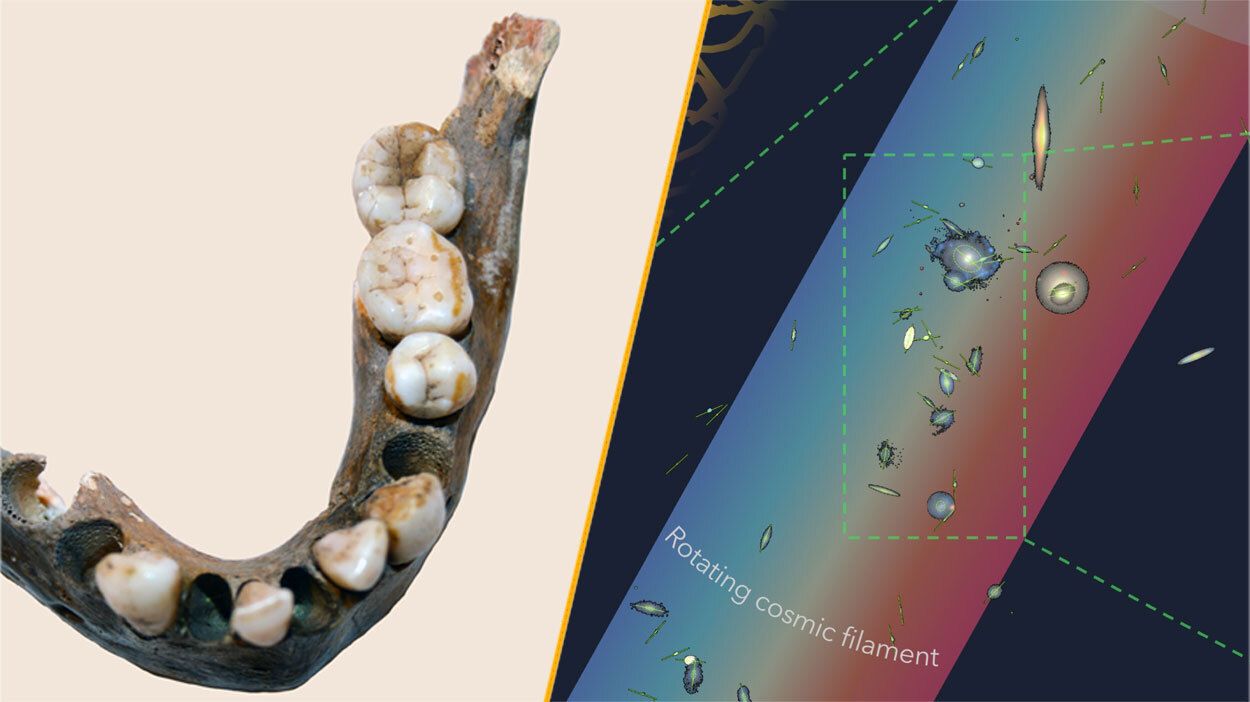
Recent scientific discoveries have captivated global audiences, ranging from ancient human remains to extraordinary cosmic phenomena. Researchers have unveiled a series of significant findings that not only enhance our understanding of the universe but also provide insights into human history and modern technology.
One of the most remarkable discoveries occurred 140 million light-years away, where astronomers identified the largest spinning structure in the universe. This colossal rotating filament, which measures wider than the Milky Way, is part of a chain of 14 galaxies. The filament spins at an astonishing speed of approximately 68 miles per second (110 kilometers per second), showcasing the dynamic nature of the cosmos.
Closer to Earth, a team of researchers focused on a human population that remained genetically isolated for 100,000 years. This study examined skeletons discovered south of the Limpopo River, a waterway that flows from South Africa into Mozambique. The remains, dating back up to 10,000 years, revealed a genetic composition markedly different from that of contemporary humans. The researchers noted that these individuals “form an extreme end of human genetic variation,” shedding light on diverse evolutionary paths.
Archaeological efforts in China have also yielded intriguing results, with experts uncovering a massive pit filled with skulls near a city that dates back 4,000 years. The discovery raised questions as nearly all the skulls belonged to males, diverging from common sacrificial patterns observed in nearby settlements. In Greece, archaeologists encountered a 2,700-year-old elaborate tomb containing a woman adorned with an upside-down crown, further complicating our understanding of ancient burial customs.
In a more contemporary context, a large ecosystem project initiated in China has led to unforeseen consequences. The Great Green Wall aimed at combating desertification has succeeded in its goal; however, it has inadvertently altered rainfall and evaporation patterns across the nation. A recent analysis indicated that these changes resulted in lower water levels in some of China’s most densely populated areas.
Amidst these findings, climate-related research continues to raise alarms. New studies suggest that the record temperature of 134°F (56.7°C) set in Death Valley in 1913 may have been impacted by human error. Additionally, a critical Atlantic current’s potential collapse could usher in centuries of drought for Europe, underscoring the urgent need for climate action.
On a lighter note, the interstellar comet 3I/ATLAS has captured the attention of scientists and enthusiasts alike. Observations from the Joan Oró Telescope in northeastern Spain revealed that the comet is experiencing “ice volcanoes,” characterized by spiral jets emitting from its surface. This phenomenon, which mirrors behaviors seen in other solar system objects, provides a closer look at the composition of cosmic visitors.
Researchers at the Massachusetts Institute of Technology (MIT) have made strides in addressing global water scarcity. They developed a method to extract drinking water from air in just minutes, utilizing sound waves to enhance efficiency. This technique is 45 times more efficient than traditional evaporation methods, making it particularly promising for arid regions.
In the realm of geological research, scientists have recently identified new reservoirs of carbon-free helium, offering hope amid a looming shortage. This helium, vital for technologies such as MRI machines and quantum computers, has traditionally been difficult to extract sustainably, but these findings could revolutionize the industry.
The week has also seen exciting developments in paleontology, with the discovery of over 18,000 dinosaur tracks in Bolivia’s Carreras Pampa. This extensive trail spans an area of 80,570 square feet (7,485 square meters), marking it as one of the world’s premier dinosaur track sites.
As scientific inquiry continues to advance our understanding of both our planet and the universe, these discoveries remind us of the profound connections between our past and present, as well as the challenges that lie ahead.







Revolutionary Photonic Ski-Jump Could Miniaturize LiDAR Systems

Couples Detox from Plastics in New Netflix Doc: Can It Boost Fertility?

Aventon Launches Affordable Full-Suspension Electric Mountain Bike

Discover Eight Must-Try Restaurants This Spring Season

UC Irvine Team Unveils Innovative Ion Pump for Water Treatment

One-Third of Americans Trim Daily Expenses for Healthcare Needs

Apple Secures First Oscar in Three Years with F1: The Movie

Fourth Graders Celebrate St. Patrick’s Day with Creative Weather Drawings

Kim Kardashian Dazzles at Vanity Fair Oscars Party 2026

Nostradamus’ 2026 Predictions: Star Death and Dark Events Loom

Breakthroughs and Challenges Await Science in 2026

OpenAI to Implement Age Verification for ChatGPT by December 2025

Electric Moto Influencer Surronster Arrested in Tijuana

Discover the Top 10 Calorie Counting Apps of 2025

Bella Hadid Shares Health Update After Treatment for Lyme Disease

Analysts Project Stronger Growth for Apple’s iPhone 17 Lineup

Top 10 Penny Stocks to Watch in 2026 for Strong Returns

Japanese Study Finds Rose Oil Can Increase Brain Gray Matter
-
 Science3 months ago
Nostradamus’ 2026 Predictions: Star Death and Dark Events Loom
-
 Science3 months ago
Breakthroughs and Challenges Await Science in 2026
-
 Technology4 months ago
OpenAI to Implement Age Verification for ChatGPT by December 2025
-
 Technology6 months ago
Electric Moto Influencer Surronster Arrested in Tijuana
-
 Technology8 months ago
Discover the Top 10 Calorie Counting Apps of 2025
-
 Health6 months ago
Bella Hadid Shares Health Update After Treatment for Lyme Disease
-
 Health7 months ago
Analysts Project Stronger Growth for Apple’s iPhone 17 Lineup
-
 Technology3 months ago
Top 10 Penny Stocks to Watch in 2026 for Strong Returns
-
 Health7 months ago
Japanese Study Finds Rose Oil Can Increase Brain Gray Matter
-

 Science5 months ago
Starship V3 Set for 2026 Launch After Successful Final Test of Version 2
-

 Technology4 weeks ago
Nvidia GTC 2026: Major Announcements Expected for AI and Hardware
-

 Education7 months ago
Harvard Secures Court Victory Over Federal Funding Cuts