
Science
Astronomers Discover Changing Dynamics Around Supermassive Black Holes

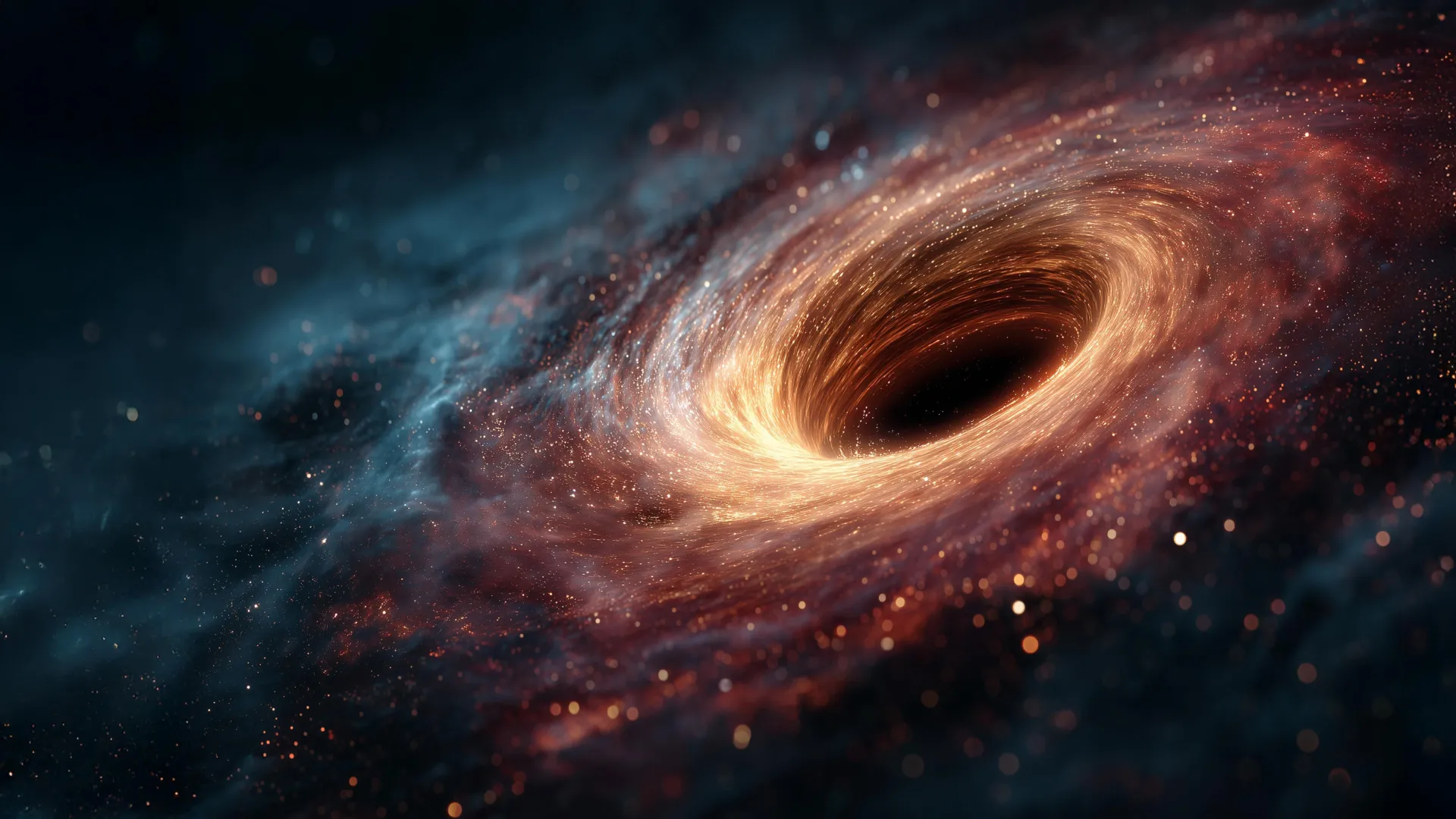
Recent observations have revealed a significant change in the relationship between ultraviolet and X-ray emissions in quasars, suggesting that the material surrounding supermassive black holes evolves over time. This unexpected finding challenges a long-held assumption in astronomy, which has persisted for nearly five decades. The study, led by researchers from the National Observatory of Athens, was published on December 27, 2025, in the Monthly Notices of the Royal Astronomical Society.
The research indicates that the behavior and structure of matter surrounding supermassive black holes may not have remained static throughout the universe’s history. Historically, quasars, which are among the brightest objects in the cosmos, have been understood to emit both ultraviolet and X-ray light in a consistent manner. However, the findings suggest that this relationship has changed significantly over the past 6.5 billion years.
Understanding Quasars and Their Brightness
Quasars, first identified in the 1960s, are powered by supermassive black holes that draw in surrounding material. As this matter spirals inward due to immense gravitational forces, it forms a disk that heats up, leading to emissions of intense light. Some quasars can emit between 100 to 1,000 times the light of an entire galaxy composed of approximately 100 billion stars. This extraordinary brightness allows quasars to be observed across vast distances in the universe.
The disk surrounding a black hole primarily emits ultraviolet light, which plays a crucial role in generating even more energetic X-ray emissions. As ultraviolet rays travel outward, they penetrate a region known as the “corona,” where they interact with highly energized particles, gaining energy and transforming into X-rays that can be detected by space-based observatories.
Reevaluating a Long-Standing Cosmic Assumption
Traditionally, astronomers have understood that the ultraviolet and X-ray emissions from quasars are closely linked. A brighter ultraviolet emission typically correlates with stronger X-ray output. This correlation has provided vital insights into the physical conditions surrounding supermassive black holes. The new study challenges the assumption that this relationship is universal, suggesting that the structure of matter around black holes may have been different in the past.
The researchers discovered that in a younger universe, approximately half its current age, the relationship between ultraviolet and X-ray emissions differed from what is observed in nearby quasars today. This indicates a fundamental shift in how the accretion disk and corona interact over billions of years. Dr. Antonis Georgakakis, one of the study’s authors, remarked, “Confirming a non-universal X-ray-to-ultraviolet relation with cosmic time is quite surprising and challenges our understanding of how supermassive black holes grow and radiate.”
To support their findings, the research team utilized data from the eROSITA X-ray telescope and archival observations from the European Space Agency’s XMM-Newton X-ray observatory. This combination allowed for a comprehensive analysis of a significantly large sample of quasars, revealing trends that were previously undetectable.
The implications of this research extend to cosmology, as the belief in a universal relationship between ultraviolet and X-ray emissions underpins certain methodologies that utilize quasars as standard candles for mapping the universe and investigating dark matter and dark energy. As Maria Chira, a postdoctoral researcher at the National Observatory of Athens and lead author of the study, noted, “The key advance here is methodological. The eROSITA survey is vast but relatively shallow—many quasars are detected with only a few X-ray photons. By combining these data in a robust Bayesian statistical framework, we could uncover subtle trends that would otherwise remain hidden.”
Looking ahead, future eROSITA all-sky scans are expected to enable astronomers to observe even fainter and more distant quasars. By integrating these forthcoming observations with next-generation X-ray and multiwavelength surveys, researchers aim to determine whether the observed changes reflect genuine physical evolution or are a result of the methodologies employed in data collection. These efforts promise to enhance our understanding of the dynamics of supermassive black holes and their role in shaping the universe.












Pharma Marketing Faces New Challenges as Regulations Shift in 2026

Pharma Marketing’s Playbook Faces Overhaul Ahead of 2026

STARTRADER Revitalizes Youth Sports with New Court in Thailand

Engage with Art, History, and Community in the Mid-Hudson Valley

San Diego County Enjoys Warmer Weather Despite Phil’s Prediction

Researchers Uncover Why Cats Are True Carnivores, Not Vegan

Enhance Your Sleep: Experts Share Lighting Tips for Better Circadian Rhythm

NASA’s Artemis II Rehearsal Faces Record Cold on Florida Coast

Special Education Students Thrive at Wilmington’s Brew and Bake Cafe

Nostradamus’ 2026 Predictions: Star Death and Dark Events Loom

OpenAI to Implement Age Verification for ChatGPT by December 2025

Discover the Top 10 Calorie Counting Apps of 2025

Bella Hadid Shares Health Update After Treatment for Lyme Disease

Analysts Project Stronger Growth for Apple’s iPhone 17 Lineup

Electric Moto Influencer Surronster Arrested in Tijuana

Harvard Secures Court Victory Over Federal Funding Cuts

Erin Bates Shares Recovery Update Following Sepsis Complications

Discover How to Reverse Image Search Using ChatGPT Effortlessly
-
 Science1 month ago
Nostradamus’ 2026 Predictions: Star Death and Dark Events Loom
-
 Technology2 months ago
OpenAI to Implement Age Verification for ChatGPT by December 2025
-
 Technology7 months ago
Discover the Top 10 Calorie Counting Apps of 2025
-
 Health5 months ago
Bella Hadid Shares Health Update After Treatment for Lyme Disease
-
 Health5 months ago
Analysts Project Stronger Growth for Apple’s iPhone 17 Lineup
-
 Technology5 months ago
Electric Moto Influencer Surronster Arrested in Tijuana
-
 Education5 months ago
Harvard Secures Court Victory Over Federal Funding Cuts
-
 Health5 months ago
Erin Bates Shares Recovery Update Following Sepsis Complications
-
 Technology6 months ago
Discover How to Reverse Image Search Using ChatGPT Effortlessly
-

 Technology7 months ago
Meta Initiates $60B AI Data Center Expansion, Starting in Ohio
-

 Science4 months ago
Starship V3 Set for 2026 Launch After Successful Final Test of Version 2
-

 Technology7 months ago
Recovering a Suspended TikTok Account: A Step-by-Step Guide