
Science
Ethylene and Oxygen Drive Rapid Plant Healing After Injury

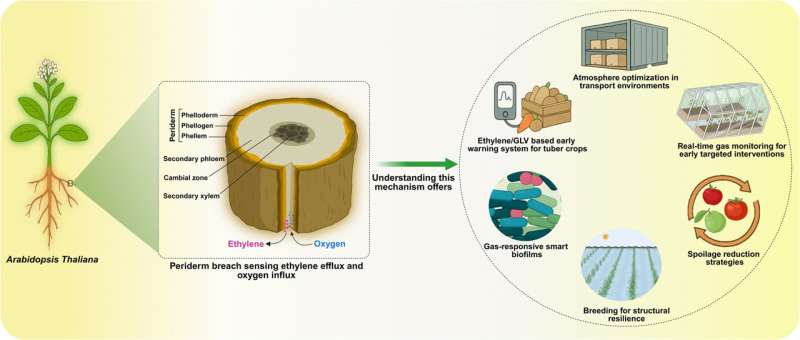
Plants have demonstrated remarkable abilities to sense and respond to tissue damage, a process crucial for their survival in challenging environments. A recent study published on December 8, 2025, in the journal Plant Communications reveals that the gases ethylene and oxygen play critical roles in the regeneration of periderm, the protective tissue layer found in many woody plants.
The research, led by Prof. Chen Yaning from the Xinjiang Institute of Ecology and Geography (XIEG) of the Chinese Academy of Sciences, provides new insights into how plants detect and respond to injuries. Understanding this process is essential, as the periderm acts as a barrier against water loss, pathogens, and mechanical damage.
Gas Dynamics in Wound Response
The study highlights that when a plant’s outer barrier is compromised, the dynamics of ethylene and oxygen within the plant tissues change significantly. According to Dr. Hassan Iqbal, the first author of the study, “When the plant’s outer barrier is damaged, endogenous ethylene gas escapes more readily into the atmosphere, while oxygen from the environment infiltrates the tissue.”
These shifts in gaseous gradients not only modify the microenvironment around the wounded area but may also activate genetic and metabolic pathways essential for periderm regeneration. The response involves stimulating cell division and differentiation in the phellogen, a layer of actively dividing cells. Following this, protective compounds such as suberin and lignin accumulate, restoring the integrity of the barrier.
Comparative Strategies Across Plant Organs
The researchers also explored how different plant organs respond to injuries through varied strategies. In roots, the dynamics of ethylene and oxygen are crucial for early damage detection. In contrast, aerial tissues, which may not develop classical periderm, often rely on volatile organic compounds, such as green leaf volatiles (GLVs), to recognize and respond to injuries. This variation underscores the specialized mechanisms that plants have evolved to cope with tissue damage across different ecological contexts.
Implications for Agriculture
The findings of this research have significant implications for agriculture and postharvest management. Enhancing natural wound-healing processes could lead to a reduction in crop losses during storage and improve the quality of staples like roots and tubers. Furthermore, the insights gained from this study could inform the development of treatments or controlled storage atmospheres that promote rapid tissue regeneration.
As scientists continue to unravel the complexities of plant responses to injury, the potential benefits for agricultural practices and food security become increasingly evident. Understanding how plants utilize gaseous cues to heal could pave the way for innovative strategies to bolster crop resilience and quality in the face of environmental challenges.
More information on this study can be found in the article by Hassan Iqbal et al., titled “Gaseous cues regenerate the periderm,” published in Plant Communications (2025), DOI: 10.1016/j.xplc.2025.101576.







New Research Uncovers Chewing Gum’s Surprising Brain Benefits

1971 DeTomaso Pantera Auctioned: A Classic Mid-Engine Marvel

Discover 2025’s Most-Borrowed Titles and Exciting Events at Your Library

Stars Dazzle on the 2026 Golden Globes Red Carpet

NASA Expedites SpaceX Crew-11 Return Following Health Alert

Selma Launches New Podiatry Center to Enhance Specialty Care Access

New Jersey Faces Challenges as Federal Rules Weaken Nursing Home Care

Discover 12 Essential Types of Wire Connectors and Their Uses

Texas Longhorns Secure Top RB Hollywood Smothers from Alabama

Nostradamus’ 2026 Predictions: Star Death and Dark Events Loom

OpenAI to Implement Age Verification for ChatGPT by December 2025

Discover the Top 10 Calorie Counting Apps of 2025

Bella Hadid Shares Health Update After Treatment for Lyme Disease

Analysts Project Stronger Growth for Apple’s iPhone 17 Lineup

Erin Bates Shares Recovery Update Following Sepsis Complications

Electric Moto Influencer Surronster Arrested in Tijuana

Discover How to Reverse Image Search Using ChatGPT Effortlessly

Meta Initiates $60B AI Data Center Expansion, Starting in Ohio
-
 Science2 weeks ago
Nostradamus’ 2026 Predictions: Star Death and Dark Events Loom
-
 Technology1 month ago
OpenAI to Implement Age Verification for ChatGPT by December 2025
-
 Technology6 months ago
Discover the Top 10 Calorie Counting Apps of 2025
-
 Health4 months ago
Bella Hadid Shares Health Update After Treatment for Lyme Disease
-
 Health4 months ago
Analysts Project Stronger Growth for Apple’s iPhone 17 Lineup
-
 Health4 months ago
Erin Bates Shares Recovery Update Following Sepsis Complications
-
 Technology4 months ago
Electric Moto Influencer Surronster Arrested in Tijuana
-
 Technology5 months ago
Discover How to Reverse Image Search Using ChatGPT Effortlessly
-
 Technology6 months ago
Meta Initiates $60B AI Data Center Expansion, Starting in Ohio
-

 Technology6 months ago
Recovering a Suspended TikTok Account: A Step-by-Step Guide
-

 Education4 months ago
Harvard Secures Court Victory Over Federal Funding Cuts
-

 Technology2 months ago
Discover 2025’s Top GPUs for Exceptional 4K Gaming Performance