
Science
Astronomers Discover Exoplanet Orbiting Twin Suns Like Tatooine

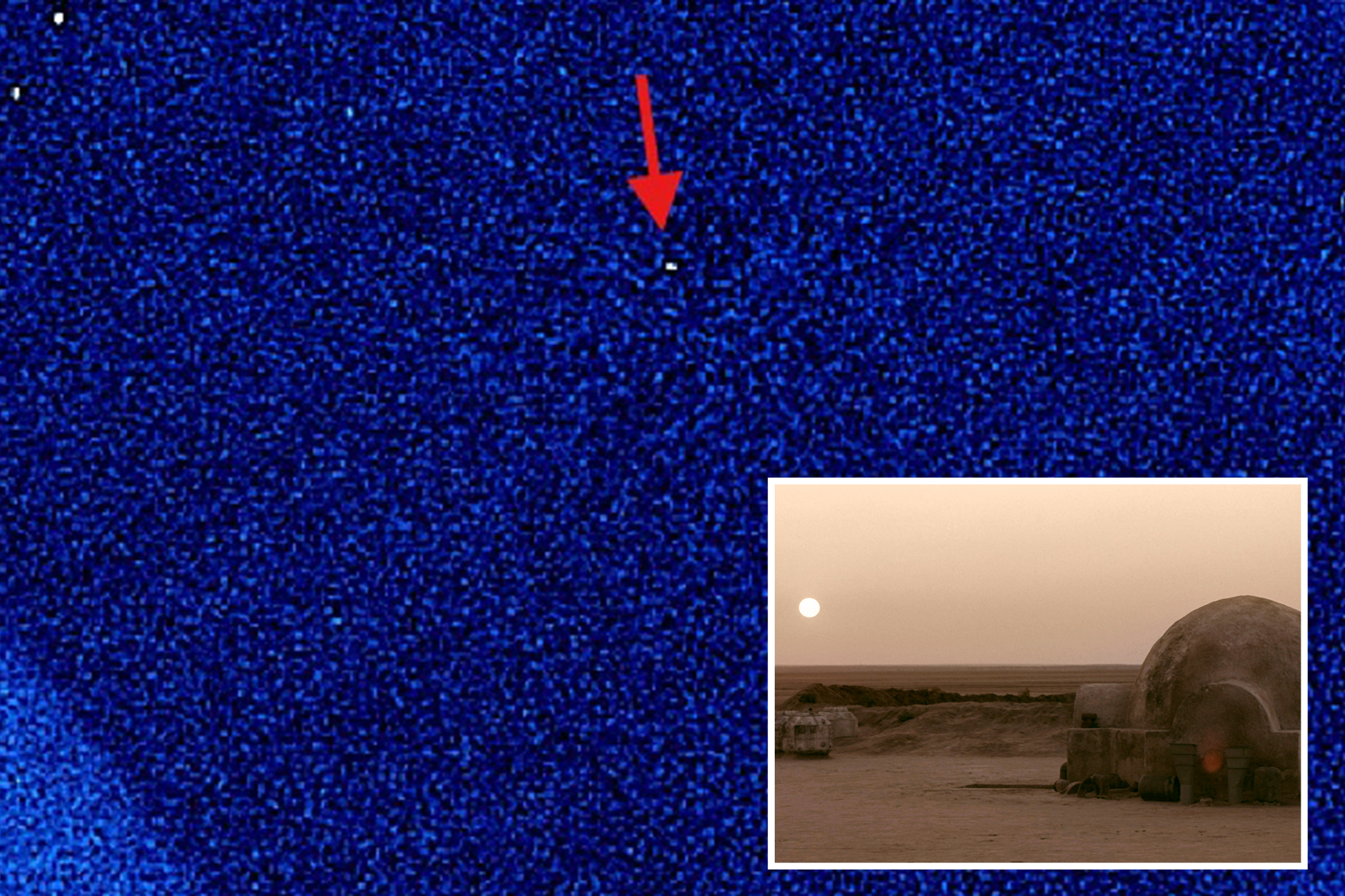
Astronomers have made a remarkable discovery of an exoplanet named HD 143811 AB b, which orbits twin stars, reminiscent of the fictional home planet Tatooine from the Star Wars universe. This finding, detailed in a study published in the journal Astronomy & Astrophysics, highlights the unique characteristics of this gas giant located approximately 446 light-years from Earth.
The research team from Northwestern University in Chicago has revealed that this exoplanet is situated closer to its twin suns than any previously recorded planet in a binary star system. It orbits its suns at a distance that is six times closer than any other known binary system exoplanet. The proximity allows scientists to analyze the trajectory of both the planet and its stars in real-time.
Jason Wang, an exoplanet imaging expert and team member, emphasized the significance of this discovery: “Of the 6,000 exoplanets that we know of, only a very small fraction orbit binaries. Of those, we only have a direct image of a handful of them.” He noted that capturing images of both the planet and its binary stars provides a unique opportunity to observe their movements simultaneously.
Despite its closeness to its suns compared to other exoplanets, HD 143811 AB b remains 80 times further from its light sources than Earth is from the Sun. The planet takes approximately 300 years to complete one orbit around its stars, while the binary stars complete their orbit every 18 days. Furthermore, HD 143811 AB b is significantly larger than Jupiter, measuring about six times its size.
Interestingly, the planet is not a new find. The data that led to its identification was previously gathered by the Gemini South telescope and its Gemini Planet Imager (GPI) instrument around a decade ago. Wang and his colleagues revisited this archival data, originally collected between 2016 and 2019, and cross-referenced it with information from the W.M. Keck Observatory. They identified a faint point of light that appeared to be in motion with a star, indicating it was likely an orbiting planet.
Wang explained that understanding the movement of celestial bodies is crucial: “If a planet is bound to a star, then it will move with the star. Sometimes, when we revisit a ‘planet,’ we find it’s not moving with its star. Then, we know it was just a photobombing star passing through.” The team confirmed that HD 143811 AB b is indeed a planet, a conclusion corroborated by independent research from the University of Exeter in the UK.
In terms of temperature, the exoplanet is extraordinarily hot, with a surface temperature of around 1,416°F, nearly twice as hot as Venus. Additionally, it is relatively young, estimated to be just 13 million years old, especially when compared to Earth’s formation approximately 4.6 billion years ago.
The precise mechanisms of how HD 143811 AB b formed around its twin suns remain unclear. Wang remarked, “Exactly how it works is still uncertain. Because we have only detected a few dozen planets like this, we don’t have enough data yet to put the picture together.”
Moving forward, scientists hope to continue their observations of HD 143811 AB b and its binary stars. This ongoing research aims to enhance our understanding of the interactions between binary stars and their orbiting planets, shedding light on the complexities of planetary formation in such unique environments.










Astronomers Discover Exoplanet Orbiting Twin Suns Like Tatooine

Sherrod Brown Advocates for Affordable Care Act in Toledo Roundtable

Apple Launches iOS 26.2 with Key Enhancements for iPhones

Community Foundation Launches Scholarship Program for Trade Education

Jobless Rate Decline: High-School Grads Narrow Gap with College Peers

Astronomers Discover Unique Exoplanet Orbiting Twin Stars

GMP Cytokine Market Expected to Grow 8.4% CAGR by 2031

L.A. Care Celebrates Innovative Partnership with Local Health Groups

Audi Launches 2025 SQ6 Sportback e-tron: A Game-Changer in SUVs

Discover the Top 10 Calorie Counting Apps of 2025

Bella Hadid Shares Health Update After Treatment for Lyme Disease

OpenAI to Implement Age Verification for ChatGPT by December 2025

Erin Bates Shares Recovery Update Following Sepsis Complications

Discover How to Reverse Image Search Using ChatGPT Effortlessly

Analysts Project Stronger Growth for Apple’s iPhone 17 Lineup

Electric Moto Influencer Surronster Arrested in Tijuana

Discover 2025’s Top GPUs for Exceptional 4K Gaming Performance

Meta Initiates $60B AI Data Center Expansion, Starting in Ohio
-
 Technology5 months ago
Discover the Top 10 Calorie Counting Apps of 2025
-
 Health3 months ago
Bella Hadid Shares Health Update After Treatment for Lyme Disease
-
 Technology2 weeks ago
OpenAI to Implement Age Verification for ChatGPT by December 2025
-
 Health3 months ago
Erin Bates Shares Recovery Update Following Sepsis Complications
-
 Technology4 months ago
Discover How to Reverse Image Search Using ChatGPT Effortlessly
-
 Health3 months ago
Analysts Project Stronger Growth for Apple’s iPhone 17 Lineup
-
 Technology3 months ago
Electric Moto Influencer Surronster Arrested in Tijuana
-
 Technology1 month ago
Discover 2025’s Top GPUs for Exceptional 4K Gaming Performance
-
 Technology5 months ago
Meta Initiates $60B AI Data Center Expansion, Starting in Ohio
-

 Technology5 months ago
Recovering a Suspended TikTok Account: A Step-by-Step Guide
-

 Health5 months ago
Tested: Rab Firewall Mountain Jacket Survives Harsh Conditions
-

 Lifestyle5 months ago
Belton Family Reunites After Daughter Survives Hill Country Floods