
Education
Chicago Mentors Empower Black Students to Overcome Challenges

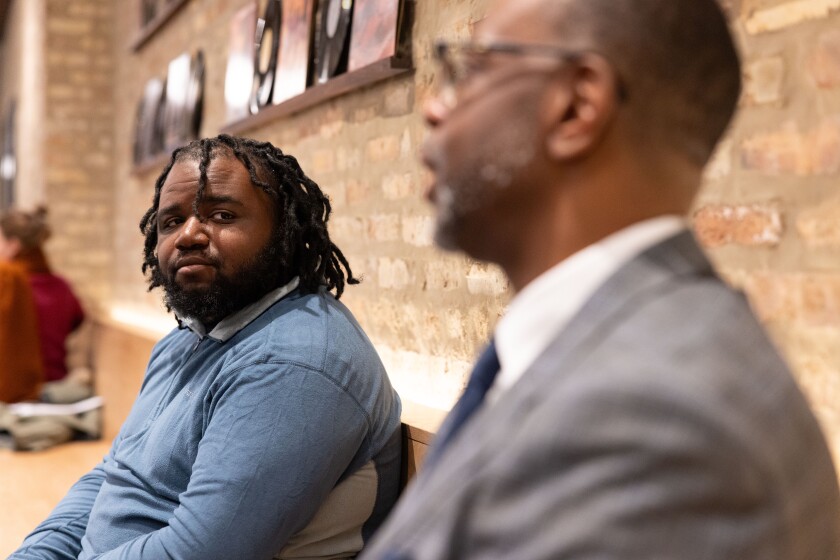
In Chicago’s Austin neighborhood, Black mentors are playing a vital role in helping young men navigate the challenges of higher education. Tyrek Gates, a 25-year-old originally from Chicago, exemplifies this journey. After struggling during his time at Alabama A&M University and ultimately flunking out, Gates returned home determined to pursue his education once again.
Gates faced significant obstacles during his first attempt at college. Balancing work to support himself while studying proved overwhelming, resulting in a GPA that fell below 2.0. “Having to basically start over — that was definitely one of the most depressing times of my life,” he reflected. Returning to his family in Austin, he took on jobs in fast food and security but remained committed to re-enrolling in school.
His aspirations were supported by his mentor, Charles Brown, who has been a father figure in Gates’ life since childhood. Brown is the pastor at New Heaven Christian Church, where Gates’ family has been members for over 15 years. “He always saw greatness in me, even when I didn’t always see it in myself,” Gates said. Brown’s encouragement and belief in Gates’ potential were pivotal during this challenging period.
The educational landscape in Austin presents profound challenges for Black men. According to data from the University of Chicago To&Through Project, only 25% of Black men who start college in the area graduate within six years. This statistic highlights a persistent issue, as the graduation rate for Black men in Austin has not improved in the past decade and remains significantly lower than that of their white counterparts, nearly 75% of whom complete their degrees in the same timeframe.
Several factors contribute to these disparities. Black students are disproportionately likely to attend underfunded schools, which often leads to lower academic expectations from educators. Furthermore, the median assets of Black families are starkly lower than those of white families, with Black households averaging under $28,000 compared to over $250,000 for white families, according to Pew Research Center data. This financial gap complicates access to higher education, as many families struggle to afford tuition and living expenses.
The impact of not graduating from college extends beyond financial burdens. Individuals without a degree face lower earning potential and are less likely to engage in community activities, such as voting and volunteering. Those who do not complete their studies often carry student debt from their time in college, further complicating their financial situations.
Brown believes that mentorship can break this cycle. He has witnessed how guidance from someone who understands their struggles can empower Black men to overcome the feeling of not belonging in college. “With a little guidance, a little patience, they can do some great things,” Brown said. His perspective is rooted in his own experiences as the first in his family to attend college.
Growing up in a racially segregated neighborhood, Brown faced significant hurdles, including the perception that he was “not college material” from an academic advisor. Despite these challenges, he persevered and eventually earned his Ph.D.. Now a professor of psychology at Malcolm X College, he actively mentors students, connecting them with necessary resources for success.
Brown emphasizes that true mentorship involves more than just advice; it requires connecting mentees to critical resources. This approach has proven effective for many students, especially those facing food insecurity, which affects Black students at a rate 1.5 times higher than their white and Asian peers. Brown has noticed that providing food can significantly enhance student engagement in class.
Gates acknowledges the profound impact Brown has had on his life. “You have to go through some type of trial in life to be able to show me that you’re worth that ‘mentor’ status,” he said. Brown’s commitment to mentorship extends beyond informal relationships; he coordinates mentoring programs for Black men at Malcolm X College, serving 30 to 50 students at any given time.
Despite the need for mentors, systemic barriers such as poverty and racism complicate the search for support in Austin. Only 20% of residents in the area hold at least an associate degree, compared to nearly 90% in wealthier neighborhoods like Lincoln Park. This disparity means that many students lack access to guidance throughout their educational journeys.
The political landscape also poses challenges. Policies aimed at eliminating support systems for students of color, such as scholarships and dedicated student centers, threaten the progress made in mentoring Black students. The Trump administration’s push to cut funding for initiatives supporting Black students has intensified the need for community-driven support.
Recently, Gates, Brown, and mentor Farid Muhammad gathered at New Sound Cafe in Austin, a former record shop that holds personal significance for Brown. Muhammad, a professor who experienced similar challenges decades earlier, shared insights from his journey as the first in his family to attend college. “You can’t start a race with a 40-mile handicap and expect to somehow create equality,” he noted, emphasizing the need for systemic change.
Gates is now within a year of completing his bachelor’s degree online and has secured fulfilling work at a nonprofit addressing homelessness. Both Brown and Muhammad have played crucial roles in this achievement. They illustrate that mentorship is not a temporary commitment but a long-term investment in the future of their community.
As Gates moves closer to graduation, he recognizes the transformative power of mentorship. “At graduation when you see them walking, you can almost see them blossom,” Muhammad said, reflecting on the profound impact this support can have. The journey of Tyrek Gates and his mentors underscores the importance of community, resilience, and the belief that every young Black man deserves the chance to succeed.











Black Mentors Empower Students in Chicago’s Austin Community

Daughter Seeks Closure After Mother’s Passing Sparks Reflection

Biotech Sector Shifts Towards Profitability, Attracts Investors

Chicago Pizzamaker Jonathan Goldsmith Triumphs Amid Challenges

HPE Addresses Critical RCE Vulnerability in OneView Software

Chicago Mentors Empower Black Students to Overcome Challenges

Navigating Holiday Etiquette: Responses to Sibling Snark and More

Researchers Launch G2PDeep Platform to Transform Precision Medicine

New York Giants Doctor Warns Against Unproven Regenerative Therapies

Discover the Top 10 Calorie Counting Apps of 2025

OpenAI to Implement Age Verification for ChatGPT by December 2025

Bella Hadid Shares Health Update After Treatment for Lyme Disease

Analysts Project Stronger Growth for Apple’s iPhone 17 Lineup

Erin Bates Shares Recovery Update Following Sepsis Complications

Discover How to Reverse Image Search Using ChatGPT Effortlessly

Electric Moto Influencer Surronster Arrested in Tijuana

Discover 2025’s Top GPUs for Exceptional 4K Gaming Performance

Meta Initiates $60B AI Data Center Expansion, Starting in Ohio
-
 Technology5 months ago
Discover the Top 10 Calorie Counting Apps of 2025
-
 Technology2 weeks ago
OpenAI to Implement Age Verification for ChatGPT by December 2025
-
 Health3 months ago
Bella Hadid Shares Health Update After Treatment for Lyme Disease
-
 Health3 months ago
Analysts Project Stronger Growth for Apple’s iPhone 17 Lineup
-
 Health3 months ago
Erin Bates Shares Recovery Update Following Sepsis Complications
-
 Technology5 months ago
Discover How to Reverse Image Search Using ChatGPT Effortlessly
-
 Technology3 months ago
Electric Moto Influencer Surronster Arrested in Tijuana
-
 Technology2 months ago
Discover 2025’s Top GPUs for Exceptional 4K Gaming Performance
-
 Technology5 months ago
Meta Initiates $60B AI Data Center Expansion, Starting in Ohio
-

 Technology5 months ago
Recovering a Suspended TikTok Account: A Step-by-Step Guide
-

 Health5 months ago
Tested: Rab Firewall Mountain Jacket Survives Harsh Conditions
-

 Lifestyle5 months ago
Belton Family Reunites After Daughter Survives Hill Country Floods