
Education
Black Mentors Empower Students in Chicago’s Austin Community

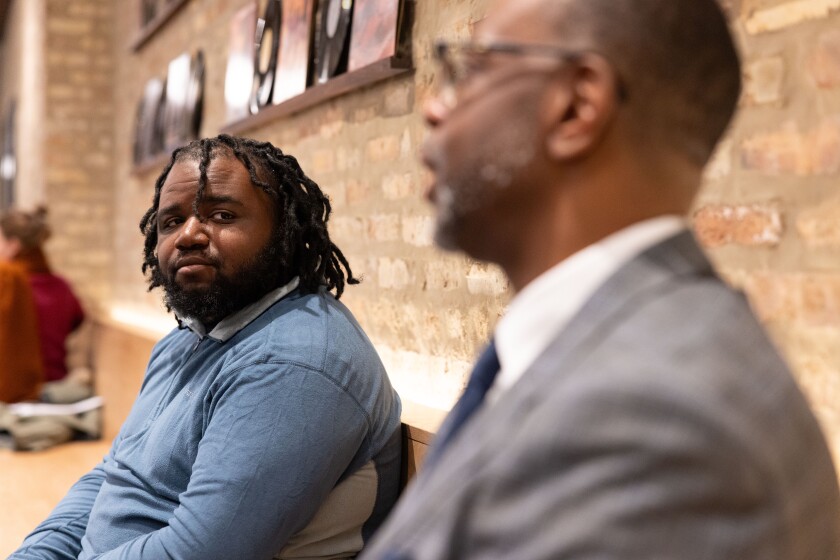
In the Austin neighborhood of Chicago, a group of dedicated Black mentors is transforming the educational landscape for young Black men, making college more accessible and achievable. Tyrek Gates, now 25, embodies this journey. After struggling during his time at Alabama A&M University, Gates found himself back in his childhood neighborhood, determined to pursue his education despite significant obstacles.
Gates faced immense pressure as he attempted to support himself financially while studying. He took on multiple jobs, including working security at campus events, but those responsibilities ultimately hindered his academic performance, leading to a GPA drop below 2.0. He eventually flunked out during his sophomore year, a setback that he described as one of the most challenging moments of his life. “Having to basically start over — that was definitely one of the most depressing times of my life,” Gates recalled.
After returning to Austin, he worked various jobs in fast food and security but remained committed to re-enrolling in school. “My mom and my dad don’t have a college degree, and I wanted to be a great example for my siblings and my future children,” Gates explained. Financial concerns loomed large, particularly as he was already in debt from his initial college experience. That’s when Charles Brown, his mentor and pastor, stepped in.
Brown, who has been a father figure to Gates since his family joined his church 15 years ago, encouraged him to see his potential beyond past failures. “He always saw greatness in me, even when I didn’t always see it in myself,” Gates said. During a pivotal sermon, Brown emphasized the importance of youth and seizing opportunities, saying, “Don’t waste your youth.” This message resonated deeply with Gates and reignited his motivation to pursue higher education.
The challenges faced by Gates are not uncommon in the Austin neighborhood, where data from the University of Chicago To&Through Project reveals that only 25% of Black men who attend college graduate within six years. This statistic has remained stagnant for the past decade and is slightly lower than the overall graduation rate for Black men in the city. In stark contrast, nearly 75% of white men complete their degrees within the same time frame.
Barriers to educational success are significant for Black students. They are three times more likely to attend underfunded K-12 schools and face lower academic expectations from predominantly white educators. This systemic disadvantage affects their self-esteem and college readiness. Additionally, the median wealth for Black families is around $28,000, compared to more than $250,000 for white families, making financial hurdles more daunting.
Graduating from college is critical; those who fail to do so miss out on better job opportunities and increased wages, while still grappling with student debt from incomplete education. Brown emphasizes that mentorship plays a crucial role in breaking this cycle. “Young Black males want better but they don’t know how to achieve that,” he said. With guidance, they can gain the confidence and resources needed to succeed.
At 56, Brown understands these struggles well. He was the first in his family to attend college, managing to balance work and studies while raising his son. His journey was not easy; it took him a decade to earn a two-year degree. He faced discouragement from an advisor who suggested he was not “college material.” Yet, this fueled his determination to prove otherwise. With perseverance, he completed his degrees and is now a psychology professor at Malcolm X College.
Brown draws from his experiences to mentor others, ensuring they receive the necessary support. He recalls a professor who helped him navigate financial challenges by encouraging him to apply for scholarships, which he believes exemplifies true mentorship. “It’s not just giving you a word or giving you advice,” Brown stated. “Mentoring is connecting you to the resources that you need to be successful.”
For many Black students, the struggle extends beyond academics. Research shows that they are 1.5 times more likely to experience food insecurity compared to their peers. Brown advocates for addressing these basic needs to facilitate better learning. “It’s hard to educate a student that’s hungry,” he noted.
Gates recognizes the profound impact Brown has had on his life. “You have to go through some type of trial in life to be able to show me that you’re worth that ‘mentor’ status,” he stated. This bond highlights the importance of shared experiences in effective mentorship.
Despite the pressing need for mentorship in Austin, the availability of such support is limited. The community faces systemic challenges, including poverty and inadequate educational resources. Only 20% of residents have at least an associate degree, contrasting sharply with neighborhoods like Lincoln Park, where nearly 90% hold similar qualifications. This disparity makes it difficult for students to find mentors who can guide them through the complexities of higher education.
In response, Brown has initiated mentoring programs for Black men at Malcolm X College, serving 30 to 50 students at a time. Additionally, he collaborates with other local leaders to pair middle and high school students with mentors to ensure they have the guidance necessary for their academic journeys.
The need for targeted support for Black students has come under scrutiny, particularly following actions taken during the administration of former President Donald Trump, which sought to eliminate initiatives aimed at assisting students of color. Such policies have only intensified the resolve of mentors like Brown, Gates, and Farid Muhammad, a dean at East-West University, who have experienced similar struggles.
During a recent meeting, Muhammad shared his own challenges as a Black student and the importance of mentorship in overcoming the barriers to success. “You can’t start a race with a 40-mile handicap and expect to somehow create equality,” he said, emphasizing the need for systemic change.
Gates, who is now a year away from completing his bachelor’s degree online, has also found fulfilling work at a nonprofit organization that supports unhoused individuals. His progress is a testament to the effectiveness of mentorship.
Muhammad encourages sustained commitment to mentorship, highlighting the transformative effect it can have on students’ lives. “At graduation when you see them walking, you can almost see them blossom,” he said. “You can just see the metamorphosis. It’s powerful.”
The stories of Gates, Brown, and Muhammad illustrate the crucial role of mentorship in empowering Black students in Chicago’s Austin neighborhood, showcasing how guidance and support can pave the way for educational success and community upliftment.













Zeldin and Grenell Challenge NY Times on EPA Pollution Report

Top Education Scholars Recognized in 2026 Edu-Scholar Rankings

San Francisco’s Free Relocation Program Struggles for Impact

E. coli’s Ingenious Tactics: Swimming Upstream to Cause Infections

Crocs Unveils Limited-Edition Coca-Cola Collection of Clogs

Zeldin and Grenell Challenge New York Times on EPA Reporting

French Mushroom Supplement Transforms Skin Health This Winter

Nightingales Showcase Vocal Mastery in Territorial Duels

New Study Links Genes to Pancreatic Cancer Risk and Prognosis

Nostradamus’ 2026 Predictions: Star Death and Dark Events Loom

OpenAI to Implement Age Verification for ChatGPT by December 2025

Discover the Top 10 Calorie Counting Apps of 2025

Bella Hadid Shares Health Update After Treatment for Lyme Disease

Analysts Project Stronger Growth for Apple’s iPhone 17 Lineup

Erin Bates Shares Recovery Update Following Sepsis Complications

Electric Moto Influencer Surronster Arrested in Tijuana

Discover How to Reverse Image Search Using ChatGPT Effortlessly

Meta Initiates $60B AI Data Center Expansion, Starting in Ohio
-
 Science2 weeks ago
Nostradamus’ 2026 Predictions: Star Death and Dark Events Loom
-
 Technology1 month ago
OpenAI to Implement Age Verification for ChatGPT by December 2025
-
 Technology6 months ago
Discover the Top 10 Calorie Counting Apps of 2025
-
 Health4 months ago
Bella Hadid Shares Health Update After Treatment for Lyme Disease
-
 Health4 months ago
Analysts Project Stronger Growth for Apple’s iPhone 17 Lineup
-
 Health4 months ago
Erin Bates Shares Recovery Update Following Sepsis Complications
-
 Technology4 months ago
Electric Moto Influencer Surronster Arrested in Tijuana
-
 Technology5 months ago
Discover How to Reverse Image Search Using ChatGPT Effortlessly
-
 Technology6 months ago
Meta Initiates $60B AI Data Center Expansion, Starting in Ohio
-

 Technology6 months ago
Recovering a Suspended TikTok Account: A Step-by-Step Guide
-

 Education4 months ago
Harvard Secures Court Victory Over Federal Funding Cuts
-

 Technology2 months ago
Discover 2025’s Top GPUs for Exceptional 4K Gaming Performance