
Top Stories
158 Giant Tortoises Released on Floreana Island in Conservation Effort

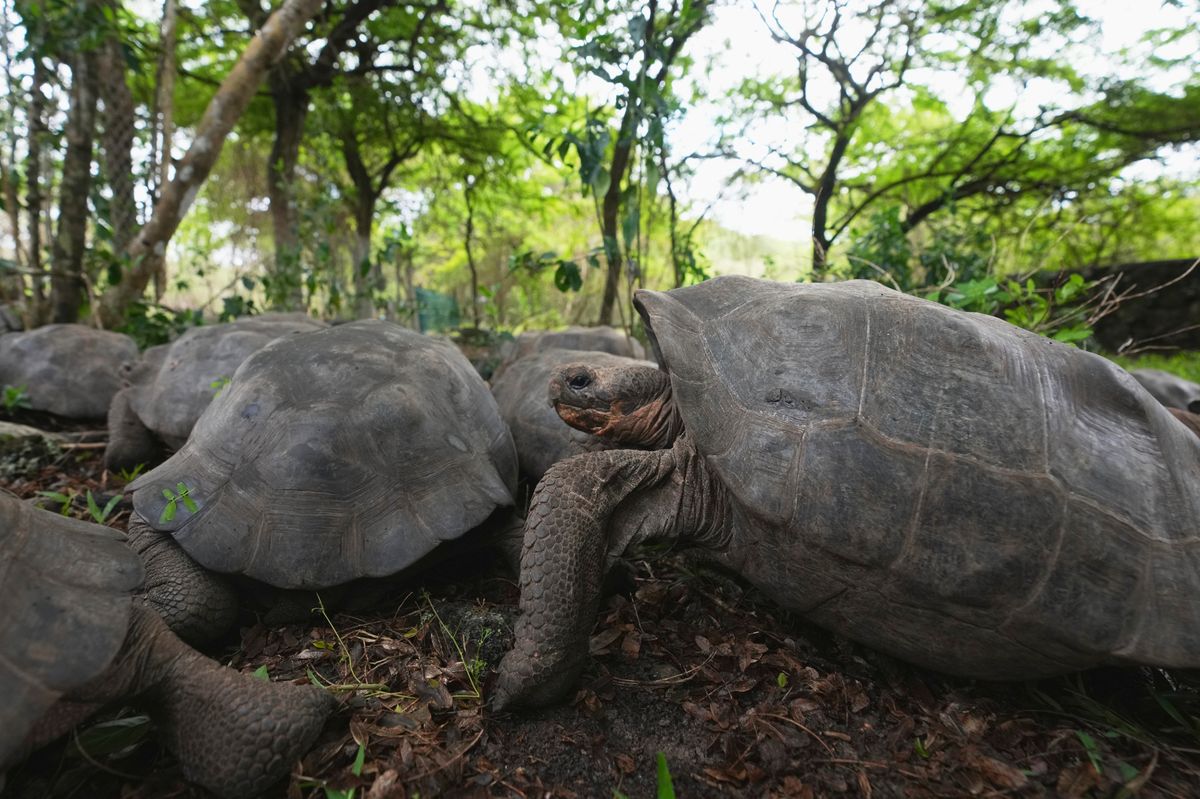
Conservationists have successfully released 158 juvenile giant tortoises on Floreana Island, part of Ecuador’s Galápagos archipelago, marking a significant step in the restoration of the island’s ecosystems. This release occurred on Friday, as the tortoises, aged between 8 and 13 years, explored their new habitat, coinciding with the onset of the season’s first winter rains.
The initiative aims to restore the island’s biodiversity, which has been severely depleted over the years. According to Fredy Villalba, director of the Galápagos National Park breeding center, these tortoises were selected for their ability to defend themselves against non-native species like rats and cats. Villalba highlighted that only the best specimens, which exhibit strong lineage, were chosen for this crucial reintroduction effort.
Restoring Genetic Diversity
The 158 tortoises released are part of a broader plan to introduce a total of 700 tortoises gradually to Floreana. Christian Sevilla, director of ecosystems for the Galápagos National Park, noted that these tortoises carry between 40% and 80% of the genetic makeup of the Chelonoidis niger, a species that has been extinct for the last 150 years. The genetic heritage of these hybrids originates from the Wolf Volcano on Isabela Island, a fact that continues to intrigue scientists.
Biologist Washington Tapia, who leads Biodiversa-Consultores, emphasized the importance of restoring not just numbers but also the genetic lineage of the species. He explained that introducing a species with significant genetic components from the original population is vital for the ecological balance of Floreana.
Challenges Ahead for Reintroduced Species
The tortoises will now share their environment with nearly 200 residents of Floreana, as well as a variety of wildlife including flamingos, iguanas, and hawks. However, they face significant threats from introduced plant species like blackberry and guava, as well as non-native animals such as rats and pigs. These invasive species could jeopardize the survival of the tortoises and the overall health of the island’s ecosystem.
Floreana Island covers an area of approximately 67 square miles and is the southernmost point of the Galápagos archipelago, located about 621 miles from the Ecuadorian mainland. The U.N. designated the Galápagos Islands as a Natural World Heritage Site in 1978, recognizing their unique biodiversity, which includes numerous species found nowhere else on Earth.
The reintroduction of these giant tortoises is a pivotal moment for conservation efforts in the Galápagos Islands, demonstrating the potential for ecological restoration when strong genetic considerations are made. As these tortoises adapt to their new surroundings, their impact on the island’s ecosystem will be closely monitored by conservationists and researchers alike.



Algonquin Students Craft Canoe for Hammarskjold High School

NAA Reveals Finalists for 2025 Robert J. Collier Trophy

Scientists Unveil ‘BioConNet’ to Revolutionize Brain Circuit Engineering

Surge in Cannabis Hyperemesis Syndrome: Key Symptoms to Recognize

Assessing Layover Options Amid Changes in Doha’s Flight Status

Applications Open for 2026 National Youth Science Camp

Sa Su Phi Unveils Chic Fall 2026 Collection at Milan Fashion Week

NASA Rover Discovers Mars Features Echoing David Bowie Lyrics

Xiaomi Unveils Leica Leitzphone, Aims at Premium Market

Nostradamus’ 2026 Predictions: Star Death and Dark Events Loom

OpenAI to Implement Age Verification for ChatGPT by December 2025

Discover the Top 10 Calorie Counting Apps of 2025

Breakthroughs and Challenges Await Science in 2026

Electric Moto Influencer Surronster Arrested in Tijuana

Bella Hadid Shares Health Update After Treatment for Lyme Disease

Analysts Project Stronger Growth for Apple’s iPhone 17 Lineup

Top 10 Penny Stocks to Watch in 2026 for Strong Returns

Japanese Study Finds Rose Oil Can Increase Brain Gray Matter
-
 Science2 months ago
Nostradamus’ 2026 Predictions: Star Death and Dark Events Loom
-
 Technology3 months ago
OpenAI to Implement Age Verification for ChatGPT by December 2025
-
 Technology7 months ago
Discover the Top 10 Calorie Counting Apps of 2025
-
 Science2 months ago
Breakthroughs and Challenges Await Science in 2026
-
 Technology5 months ago
Electric Moto Influencer Surronster Arrested in Tijuana
-
 Health5 months ago
Bella Hadid Shares Health Update After Treatment for Lyme Disease
-
 Health6 months ago
Analysts Project Stronger Growth for Apple’s iPhone 17 Lineup
-
 Technology2 months ago
Top 10 Penny Stocks to Watch in 2026 for Strong Returns
-
 Health6 months ago
Japanese Study Finds Rose Oil Can Increase Brain Gray Matter
-

 Science4 months ago
Starship V3 Set for 2026 Launch After Successful Final Test of Version 2
-

 Education6 months ago
Harvard Secures Court Victory Over Federal Funding Cuts
-

 Health6 months ago
Erin Bates Shares Recovery Update Following Sepsis Complications