
Science
Researchers Innovate Durable Battery Electrodes Using Dry Process

A collaborative team of researchers from South Korea and the United Kingdom has made significant advancements in the manufacturing of secondary battery electrodes. Led by Dr. Gyujin Song from the Korea Institute of Energy Research, along with Dr. Kwon-Hyung Lee of the University of Cambridge and Professor Tae-Hee Kim of the University of Ulsan, the team has developed a new dry-process technology that addresses key limitations of traditional electrode production methods.
Conventional battery electrode manufacturing techniques generally fall into two categories: wet and dry processes. The wet method, which utilizes a solvent-based binder, has been the dominant approach due to its reliability and ability to ensure uniform mixing of materials. However, this method relies heavily on toxic organic solvents, resulting in significant environmental concerns and increased production costs due to lengthy drying times. In contrast, the newly developed dry-process technology eliminates the need for solvents, enabling faster production and reducing environmental impact.
The innovative dry process creates a dual-fibrous structure within the electrode, incorporating both thin “thread-like” and thick “rope-like” fibers. This unique architecture addresses the common issues of low mixing strength and performance degradation typically associated with conventional dry methods. Traditional dry processes often limit the range of binder materials that can be used, primarily relying on polytetrafluoroethylene (PTFE), a substance known for its heat and chemical resistance.
To enhance the structural integrity of the electrodes, the researchers implemented a multi-step mixing process. Initially, a small amount of PTFE binder is added to form a fine fibrous network that connects the active materials and conductive additives. Subsequently, a larger quantity of binder is incorporated, resulting in the formation of robust fibers that enhance the electrode’s strength and stability.
This dual-fiber architecture not only allows for uniform dispersion of the electrode materials but also improves the electrochemical performance of the batteries. Analysis conducted through electrochemical reaction-resistance mapping revealed that the electrodes demonstrated fast and uniform reaction kinetics, a crucial aspect for minimizing energy loss during battery operation.
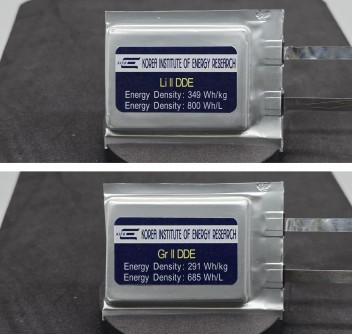
In performance tests, the newly developed dry electrode achieved an impressive areal capacity of 10.1 mAh/cm2. A pouch-type lithium metal anode cell utilizing this electrode reached an energy density of 349 Wh/kg, which is approximately 40% higher than that of standard commercial electrodes, typically around 250 Wh/kg. Additionally, a pouch cell with a graphite anode achieved 291 Wh/kg, representing a 20% increase compared to cells produced through wet processes under identical conditions.
Dr. Gyujin Song emphasized the importance of this study, stating, “This research establishes a novel process technology capable of simultaneously resolving the two core challenges of dry electrodes: electrochemical uniformity and mechanical durability. We anticipate that this innovation will enhance the cost competitiveness of the secondary battery industry and find applications in electric vehicles and energy storage systems.”
This research was supported by the Ministry of Science and ICT’s “Global TOP Research Program” and “Creative Allied Project.” The findings were published in the September 2023 issue of Energy & Environmental Science, a prestigious journal in the field of energy research. As the demand for efficient and environmentally friendly battery technologies continues to rise, this breakthrough has the potential to significantly influence the future of energy storage solutions globally.












AI Revolutionizes Finance: Experts Predict Transformative Changes

Trump Suggests Self-Nomination for Kennedy Center Honors

Researchers Innovate Durable Battery Electrodes Using Dry Process

Daily Horoscope for December 8, 2025: Focus on Personal Growth

AI Revolutionizes Finance: Experts Predict Major Transformations

Philadelphia School District Plans for Potential SEPTA Strike Disruption

Trump Hosts Kennedy Center Honors, Redefining Cultural Celebration

Insect Pupae Use Hissing Sounds to Deter Predators, Study Finds

Virtual Program Shows Promise in Reducing Lymphoma Treatment Side Effects

Discover the Top 10 Calorie Counting Apps of 2025

Bella Hadid Shares Health Update After Treatment for Lyme Disease

OpenAI to Implement Age Verification for ChatGPT by December 2025

Erin Bates Shares Recovery Update Following Sepsis Complications

Discover How to Reverse Image Search Using ChatGPT Effortlessly

Electric Moto Influencer Surronster Arrested in Tijuana

Discover 2025’s Top GPUs for Exceptional 4K Gaming Performance

Meta Initiates $60B AI Data Center Expansion, Starting in Ohio

Recovering a Suspended TikTok Account: A Step-by-Step Guide
-
 Technology5 months ago
Discover the Top 10 Calorie Counting Apps of 2025
-
 Health3 months ago
Bella Hadid Shares Health Update After Treatment for Lyme Disease
-
 Technology7 days ago
OpenAI to Implement Age Verification for ChatGPT by December 2025
-
 Health3 months ago
Erin Bates Shares Recovery Update Following Sepsis Complications
-
 Technology4 months ago
Discover How to Reverse Image Search Using ChatGPT Effortlessly
-
 Technology3 months ago
Electric Moto Influencer Surronster Arrested in Tijuana
-
 Technology1 month ago
Discover 2025’s Top GPUs for Exceptional 4K Gaming Performance
-
 Technology5 months ago
Meta Initiates $60B AI Data Center Expansion, Starting in Ohio
-
 Technology5 months ago
Recovering a Suspended TikTok Account: A Step-by-Step Guide
-

 Health3 months ago
Analysts Project Stronger Growth for Apple’s iPhone 17 Lineup
-

 Health5 months ago
Tested: Rab Firewall Mountain Jacket Survives Harsh Conditions
-

 Lifestyle5 months ago
Belton Family Reunites After Daughter Survives Hill Country Floods