
Science
James Webb Space Telescope Reveals Unexplained Helium Tails from WASP-121b

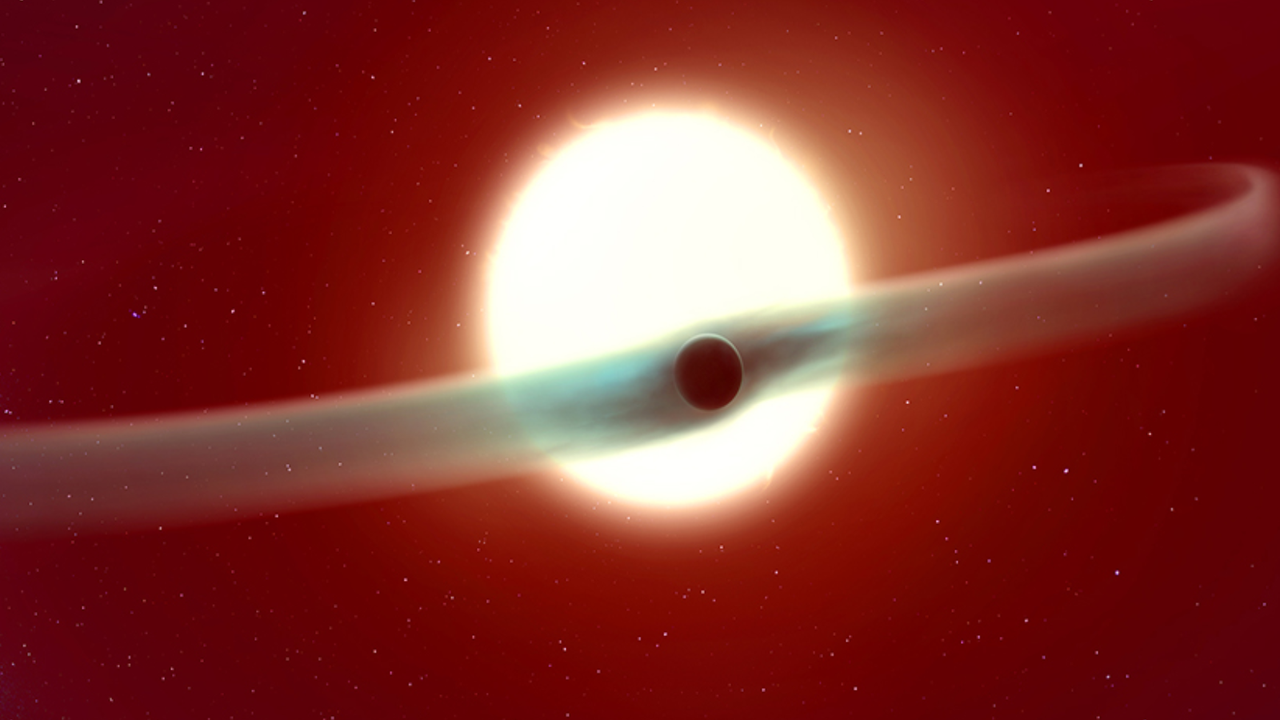
Astronomers using the James Webb Space Telescope (JWST) have made a groundbreaking discovery regarding a distant exoplanet, known as WASP-121b or “Tylos.” This “hot Jupiter,” located approximately 858 light-years from Earth, exhibits two extraordinarily long tails made of helium, a phenomenon that current scientific models struggle to explain. The findings mark the first comprehensive study of gases leaking from an exoplanet during its complete orbit, significantly advancing our understanding of atmospheric escape.
Located in a close orbit around its parent star, WASP-121b exemplifies an “ultrahot Jupiter.” It completes an orbit in just 30 hours while enduring extreme temperatures of around 4,200 degrees Fahrenheit (2,300 degrees Celsius). This intense heat causes lighter elements like hydrogen and helium to escape into space, a gradual process that can take millions of years and significantly alters the planet’s atmosphere.
Traditionally, scientists have observed atmospheric escape during a phenomenon known as a “transit,” where an exoplanet passes in front of its star. However, this method left gaps in understanding whether atmospheric gases continued to leak outside of these limited observational periods. The recent JWST observations, which utilized the telescope’s Near-Infrared Spectrograph (NIRSpec) over 37 consecutive hours, provide the first continuous evidence of helium presence and its escape during a full orbit.
Discovering Dual Helium Tails
The research team, led by Romain Allart from the University of Montreal, expressed their surprise at the duration of the helium escape. “This discovery reveals the complexity of the physical processes that sculpt exoplanetary atmospheres and their interaction with their stellar environment,” Allart stated. The findings illustrate the intricate dynamics at play in exoplanetary atmospheres, suggesting that scientists are only beginning to uncover the full complexity of these distant worlds.
Helium serves as a crucial indicator of atmospheric escape from exoplanets, and the sensitivity of the JWST allows for observations at great distances. By analyzing the light absorbed by helium atoms, researchers discovered that the gas envelope surrounding WASP-121b extends far beyond the planet itself. The helium signal persisted for over half of the planet’s orbit, establishing the longest continuous detection of atmospheric escape recorded to date.
One intriguing aspect of the study is the formation of two distinct helium tails. The first tail is pushed backward by radiation and stellar winds from the parent star, while the second tail leads the planet in its orbit, likely influenced by its gravity. Together, these tails measure over 100 times the width of WASP-121b and extend three times the distance from the planet to its star. The presence of dual tails poses a challenge to existing scientific models.
Implications for Future Research
Despite the significant findings, the research team acknowledges that these observations reveal limitations in current numerical models of exoplanetary atmospheres. As Vincent Bourrier from the University of Geneva noted, “Very often, new observations reveal the limitations of our numerical models and push us to explore new physical mechanisms to further our understanding of these distant worlds.”
The team’s research was published on December 8, 2023, in the journal Nature Communications. As scientists continue to analyze these unique characteristics of WASP-121b, this discovery opens new avenues for exploration in exoplanetary science and enhances our understanding of how these distant worlds evolve over time.








Revolutionary Photonic Ski-Jump Could Miniaturize LiDAR Systems

Couples Detox from Plastics in New Netflix Doc: Can It Boost Fertility?

Aventon Launches Affordable Full-Suspension Electric Mountain Bike

Discover Eight Must-Try Restaurants This Spring Season

UC Irvine Team Unveils Innovative Ion Pump for Water Treatment

One-Third of Americans Trim Daily Expenses for Healthcare Needs

Apple Secures First Oscar in Three Years with F1: The Movie

Fourth Graders Celebrate St. Patrick’s Day with Creative Weather Drawings

Kim Kardashian Dazzles at Vanity Fair Oscars Party 2026

Nostradamus’ 2026 Predictions: Star Death and Dark Events Loom

Breakthroughs and Challenges Await Science in 2026

Electric Moto Influencer Surronster Arrested in Tijuana

OpenAI to Implement Age Verification for ChatGPT by December 2025

Discover the Top 10 Calorie Counting Apps of 2025

Bella Hadid Shares Health Update After Treatment for Lyme Disease

Analysts Project Stronger Growth for Apple’s iPhone 17 Lineup

Japanese Study Finds Rose Oil Can Increase Brain Gray Matter

Top 10 Penny Stocks to Watch in 2026 for Strong Returns
-
 Science3 months ago
Nostradamus’ 2026 Predictions: Star Death and Dark Events Loom
-
 Science4 months ago
Breakthroughs and Challenges Await Science in 2026
-
 Technology7 months ago
Electric Moto Influencer Surronster Arrested in Tijuana
-
 Technology4 months ago
OpenAI to Implement Age Verification for ChatGPT by December 2025
-
 Technology9 months ago
Discover the Top 10 Calorie Counting Apps of 2025
-
 Health7 months ago
Bella Hadid Shares Health Update After Treatment for Lyme Disease
-
 Health7 months ago
Analysts Project Stronger Growth for Apple’s iPhone 17 Lineup
-
 Health7 months ago
Japanese Study Finds Rose Oil Can Increase Brain Gray Matter
-
 Technology4 months ago
Top 10 Penny Stocks to Watch in 2026 for Strong Returns
-

 Science6 months ago
Starship V3 Set for 2026 Launch After Successful Final Test of Version 2
-

 Technology1 month ago
Nvidia GTC 2026: Major Announcements Expected for AI and Hardware
-

 Education7 months ago
Harvard Secures Court Victory Over Federal Funding Cuts