
Science
Researchers Uncover Ancient Roman Stairway in Pompeii’s Ruins

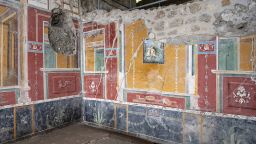
Researchers have made a significant discovery in the ancient city of Pompeii, revealing an intricate Roman stairway that sheds light on the architectural and social landscape of the time. This finding emerges nearly two millennia after the catastrophic eruption of Mount Vesuvius in AD 79, which buried the city under layers of volcanic ash and debris, preserving it in a state of eerie stillness.
The eruption resulted in the deaths of many residents while others managed to escape. The excavations that began in 1748 have since unveiled a wealth of artifacts, buildings, and the remnants of daily life within the city. However, questions about the urban architecture and the everyday experiences of its citizens have persisted. To address these gaps, researchers are employing a novel combination of digital archaeology techniques, including remote sensing technology and close-range photography.
Digital Archaeology Reveals Lost Aspects of Pompeii
The innovative approach, led by the Pompeii Reset project and detailed in the recent publication in the E-Journal of the Excavations of Pompeii, aims to reconstruct architectural elements that were lost to time. Co-lead study author Dr. Susanne Muth, a professor at Humboldt University of Berlin, noted, “By reconstructing the lost architecture, we gain a more nuanced and historically accurate understanding of the ancient city and life within it.”
During a visit to Pompeii in 2022, Dr. Muth was inspired by the Archaeological Park of Pompeii’s efforts to preserve the site amid challenges posed by climate change. This led to a collaboration with the park, leveraging digital techniques to document remaining structures and create three-dimensional models. Techniques such as LiDAR scans and detailed photography allow the team to visualize architectural features that have long been obscured, including indications of missing upper floors.
Research indicates that life continued among the ruins even after the eruption, as some inhabitants returned to the city decades later. Gabriel Zuchtriegel, director of the archaeological park, explained that the volcanic debris reached approximately five meters (16 feet) high, with the upper floors still visible above the ash. The remnants of ground floors transformed into cellars, where ovens and mills were later found.
Unveiling the Casa del Tiaso
As researchers explored the upper levels of Pompeii’s buildings, they focused on a newly excavated residence known as the Casa del Tiaso, or the House of the Thiasos. This opulent home likely belonged to an influential family and featured large banquet rooms and a private thermal bath complex. The discovery of a monumental stone staircase leading to a second floor, alongside indentations suggesting the presence of a wooden staircase, has led researchers to believe that the structure may have once included a tower.
Dr. Muth remarked, “When we began to reconstruct this room in terms of its lost architecture, it became clear to us that it could only be a tower.” This finding is particularly significant as it suggests that towers, often associated with rural villas, may have also existed in urban settings, challenging previous assumptions about the architectural landscape of Pompeii.
The presence of towers in such residences could indicate a desire to mirror the grandeur of countryside villas, serving not only as a functional space for gatherings but also as a status symbol for the homeowner. Ancient Roman texts and art have depicted such towers, reinforcing their cultural significance.
While the idea of towers in urban Pompeii was previously dismissed, the Casa del Tiaso’s findings suggest a more complex and dynamic architectural history than previously understood. This discovery opens new avenues for research into the social and residential structures of Pompeii’s inhabitants.
In the context of preserving Pompeii’s cultural heritage, the digital reconstruction efforts aim to provide a clearer picture of the city’s past. These efforts include the creation of 3D models that not only reflect the buildings’ structural design but also offer insights into how they were used and how they interacted with the lives of their residents.
As researchers continue to explore the remaining buried sections of Pompeii, they hope to uncover more evidence of upper floors and other lost structures. The aim is to piece together a more complete vision of the city’s skyline, which has been largely obscured by the eruption’s aftermath.
Dr. Muth emphasized the importance of these findings: “We know that cities and settlements in the past must often have had a taller skyline than we now have direct access to, from Neolithic Çatalhöyük to the cities of medieval Italy, and the Roman world is no exception.”
Digital archaeology is not simply about creating reconstructions; it serves as a method for understanding the complexities of ancient life. The ongoing work at Pompeii highlights the potential of modern technology to bridge the gap between the past and present, ensuring that the lessons and legacies of this ancient civilization endure for future generations.





WJXT Celebrates Success with Four Suncoast Emmy Awards

Researchers Secure $1.25M Grant for Hawaiʻi Hazard Monitoring Sensors

Study Reveals Potential for Expanded Donor Pool in Stem Cell Transplants

Recognize the Signs: When It’s Time to Upgrade Your Smartphone

Milligan University Celebrates Fall Commencement on December 12

WJXT Celebrates Four Wins at Suncoast Emmy Awards

László Krasznahorkai Delivers Insightful Lecture in Stockholm

Study Finds Deep-Sea Mining Reduces Animal Abundance by 37%

Long Butterfly Cut with Bangs Emerges as 2026 Hair Trend

Discover the Top 10 Calorie Counting Apps of 2025

Bella Hadid Shares Health Update After Treatment for Lyme Disease

OpenAI to Implement Age Verification for ChatGPT by December 2025

Erin Bates Shares Recovery Update Following Sepsis Complications

Discover How to Reverse Image Search Using ChatGPT Effortlessly

Discover 2025’s Top GPUs for Exceptional 4K Gaming Performance

Electric Moto Influencer Surronster Arrested in Tijuana

Meta Initiates $60B AI Data Center Expansion, Starting in Ohio

Recovering a Suspended TikTok Account: A Step-by-Step Guide
-
 Technology5 months ago
Discover the Top 10 Calorie Counting Apps of 2025
-
 Health3 months ago
Bella Hadid Shares Health Update After Treatment for Lyme Disease
-
 Technology6 days ago
OpenAI to Implement Age Verification for ChatGPT by December 2025
-
 Health3 months ago
Erin Bates Shares Recovery Update Following Sepsis Complications
-
 Technology4 months ago
Discover How to Reverse Image Search Using ChatGPT Effortlessly
-
 Technology1 month ago
Discover 2025’s Top GPUs for Exceptional 4K Gaming Performance
-
 Technology3 months ago
Electric Moto Influencer Surronster Arrested in Tijuana
-
 Technology5 months ago
Meta Initiates $60B AI Data Center Expansion, Starting in Ohio
-
 Technology5 months ago
Recovering a Suspended TikTok Account: A Step-by-Step Guide
-

 Health5 months ago
Tested: Rab Firewall Mountain Jacket Survives Harsh Conditions
-

 Health3 months ago
Analysts Project Stronger Growth for Apple’s iPhone 17 Lineup
-

 Lifestyle5 months ago
Belton Family Reunites After Daughter Survives Hill Country Floods