
Science
Comet ATLAS Disintegrates in Solar Encounter, Revealing Key Data

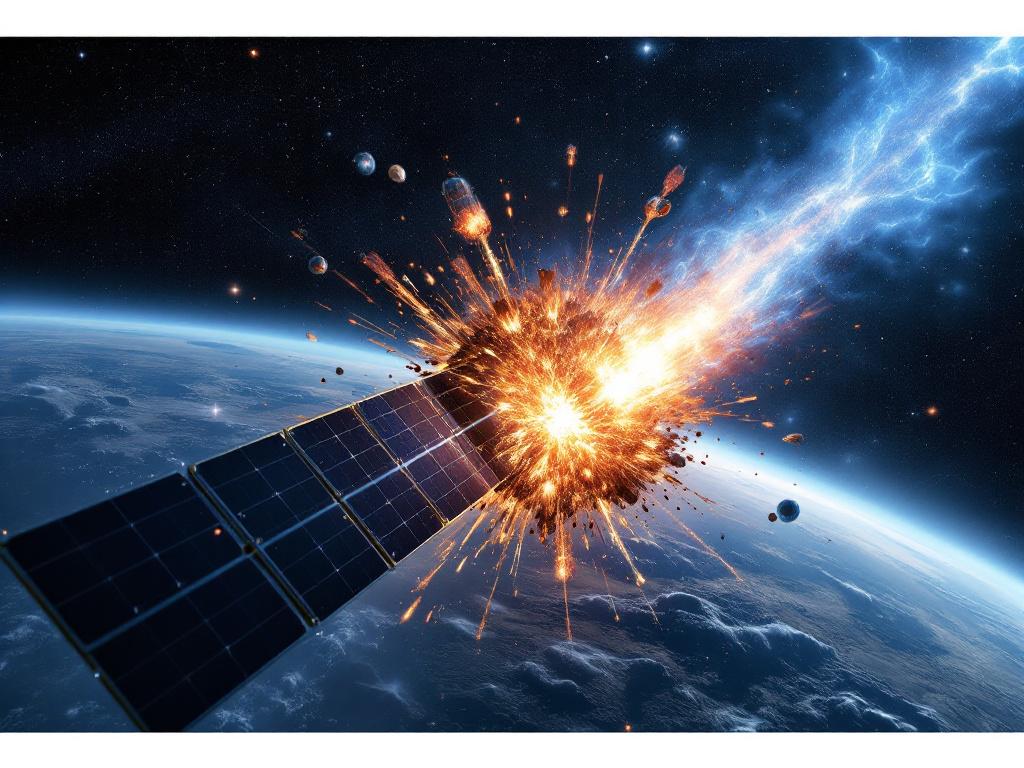
The disintegration of Comet C/2024 S1, known as ATLAS, has provided significant insights into solar dynamics and the fragility of comets in close proximity to the Sun. Captured by NASA’s Solar and Heliospheric Observatory (SOHO), the event illustrates how coronal mass ejections (CMEs) can drastically affect celestial bodies, leading to their destruction before they complete their perihelion passage.
Discovered by the Asteroid Terrestrial-impact Last Alert System (ATLAS) in Hawaii, Comet ATLAS was initially anticipated to be a spectacular sight visible from the Northern Hemisphere. Instead, it met a catastrophic end, vaporized by intense solar radiation and plasma from a CME. This incident serves as a critical case study, underscoring the unpredictable nature of comets and the need for improved space situational awareness.
The Kreutz Sungrazers and Their Vulnerability
Comet ATLAS belonged to the Kreutz family of sungrazers, known for their orbits that bring them perilously close to the Sun. These comets are believed to be remnants of a larger comet that fragmented centuries ago. The dynamics of sungrazers are particularly relevant to aerospace and defense sectors, as they can act as natural probes of solar activity.
As Comet ATLAS approached the Sun, it faced extreme tidal forces and temperatures that could exceed several thousand degrees Celsius. Analysis by Space.com revealed that the comet was likely smaller and less dense than initially thought, lacking the structural integrity required to survive its close encounter with the Sun. This disintegration offers valuable data on the composition of such ancient solar system objects, suggesting they are often more porous and volatile than previously detected.
Impacts of Coronal Mass Ejections
The timing of a CME coinciding with the comet’s approach created a dramatic scenario. A CME is a significant release of plasma and magnetic field from the solar corona, and when it interacts with a comet, the consequences can be devastating. For Comet ATLAS, the kinetic energy and thermal effects of the solar outflow accelerated the sublimation process, leading to its total disintegration.
For industries reliant on satellite technology and power infrastructure, understanding these interactions is critical. Observing how the comet’s tail twisted and ultimately disconnected offers insights into solar wind dynamics, aiding in the prediction of how similar CMEs can impact Earth’s magnetosphere. According to NASA’s analyses, comprehension of these solar storms is vital for safeguarding billions of dollars in space assets and terrestrial electrical systems.
The imagery of this event was collected by the Large Angle and Spectrometric Coronagraph (LASCO) aboard SOHO. Launched in 1995 as a collaborative effort between NASA and the European Space Agency (ESA), SOHO has become a cornerstone for solar observation. Its longevity highlights a vulnerability in space weather monitoring: reliance on aging infrastructure. While newer missions like the Parker Solar Probe and Solar Orbiter provide detailed data, SOHO’s unique position at Lagrange Point 1 (L1) enables continuous monitoring of sungrazing comets and CMEs.
This disintegration emphasizes the importance of maintaining our observational capabilities. Without tools like coronagraphs to block solar glare, such celestial events would remain invisible to terrestrial observers until it is too late.
Lessons for Planetary Defense
The ATLAS survey system, which detected Comet ATLAS, primarily focuses on near-Earth objects (NEOs) that pose potential impacts to our planet. While the discovery of a sungrazer is scientifically valuable, it is a byproduct of planetary defense efforts. The rapid tracking of C/2024 S1 demonstrates the capability of the ATLAS hardware, supported by NASA’s Planetary Defense Coordination Office.
The comet’s fate also raises questions regarding the efficacy of kinetic impactors for planetary defense. If an icy body can be entirely vaporized by solar radiation, it challenges the assumptions about the density and cohesion of potential impactors. Many deflection strategies rely on the idea that these objects are solid masses; if an incoming threat were more similar to the fragmented structure of Comet ATLAS, efforts to deflect it could lead to fragmentation rather than effective diversion.
Insights from these solar interactions are reshaping discussions at the European Space Agency and other defense organizations. The economic implications of such events extend beyond scientific interest. The insurance and reinsurance sectors for satellite operations depend heavily on risk models that incorporate space weather activity. Periods of heightened solar activity, marked by frequent CMEs, correlate with increased satellite anomalies and potential service disruptions.
The timing of the comet’s disintegration coincided with a solar maximum, a period of increased solar activity. Industry analysts closely monitor such events to assess the solar wind’s density. When comets reveal dense or fast-moving CMEs, they serve as early warning systems for potential geomagnetically induced currents (GICs) that can disrupt power lines.
In summary, the dramatic disintegration of Comet C/2024 S1 not only provides a glimpse into the harsh realities of the solar environment but also reinforces the necessity for advanced solar observation capabilities. While the loss of ATLAS may disappoint amateur astronomers hoping for a bright display, it represents a significant opportunity for scientific data collection. The event serves as a reminder of the dynamic interactions within our solar system and the ongoing importance of monitoring these phenomena for both scientific and practical applications.







Boys & Girls Club of Lake Tahoe Hosts 4th Holiday Sausage Party

Major Study Reveals Nose Microbiome’s Role in Staph Aureus Risks

Researchers Unveil New Strategy Against Aggressive Blood Cancer

Cyber Monday Discounts Still Available on Top Tech Gadgets

Yale’s Josh Geballe Discusses Innovations in Entrepreneurship

Boys & Girls Club Hosts 4th Annual Holiday Sausage Party

Wedding Gift Miscommunication Strains Friendship Between Families

New Study Offers Key Harm Reduction Tips for First-Time Psychedelic Users

TrumpRx Initiative Aims to Lower Prescription Drug Prices

Discover the Top 10 Calorie Counting Apps of 2025

Bella Hadid Shares Health Update After Treatment for Lyme Disease

Erin Bates Shares Recovery Update Following Sepsis Complications

Discover How to Reverse Image Search Using ChatGPT Effortlessly

Discover 2025’s Top GPUs for Exceptional 4K Gaming Performance

Electric Moto Influencer Surronster Arrested in Tijuana

Meta Initiates $60B AI Data Center Expansion, Starting in Ohio

Recovering a Suspended TikTok Account: A Step-by-Step Guide

Tested: Rab Firewall Mountain Jacket Survives Harsh Conditions
-
 Technology5 months ago
Discover the Top 10 Calorie Counting Apps of 2025
-
 Health2 months ago
Bella Hadid Shares Health Update After Treatment for Lyme Disease
-
 Health3 months ago
Erin Bates Shares Recovery Update Following Sepsis Complications
-
 Technology4 months ago
Discover How to Reverse Image Search Using ChatGPT Effortlessly
-
 Technology1 month ago
Discover 2025’s Top GPUs for Exceptional 4K Gaming Performance
-
 Technology2 months ago
Electric Moto Influencer Surronster Arrested in Tijuana
-
 Technology5 months ago
Meta Initiates $60B AI Data Center Expansion, Starting in Ohio
-
 Technology5 months ago
Recovering a Suspended TikTok Account: A Step-by-Step Guide
-
 Health4 months ago
Tested: Rab Firewall Mountain Jacket Survives Harsh Conditions
-

 Lifestyle5 months ago
Belton Family Reunites After Daughter Survives Hill Country Floods
-

 Technology4 months ago
Harmonic Launches AI Chatbot App to Transform Mathematical Reasoning
-

 Technology3 months ago
Uncovering the Top Five Most Challenging Motorcycles to Ride