
Science
Astronomers Investigate Water Retention on Exoplanets Around Variable Stars


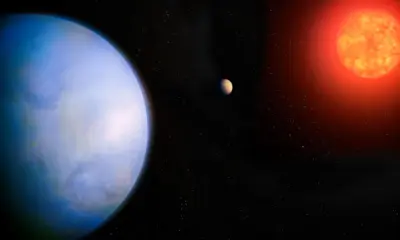
Recent research published in The Astronomical Journal explores the relationship between star variability—fluctuations in brightness—and the habitability of exoplanets. A team of scientists conducted an extensive analysis of nine exoplanets orbiting stars that differ significantly from our Sun. Their findings suggest that the variability of these stars plays a minimal role in determining the habitability of these distant worlds.
The study examined exoplanets that reside in the habitable zones of their respective stars. These planets include TOI-1227 b (328 light-years away), HD 142415 b (116 light-years), HD 147513 b (42 light-years), HD 221287 b (182 light-years), BD-08 2823 c (135 light-years), KELT-6 c (785 light-years), HD 238914 b (1,694 light-years), HD 147379 b (35 light-years), and HD 63765 b (106 light-years). The primary objective was to assess how the variability of these stars affects the equilibrium temperature of their exoplanets and their ability to retain water.
Equilibrium temperature is defined as the temperature a planetary body would achieve if heat transfer ceased. The researchers determined that the variability of the nine studied stars has little effect on the equilibrium temperature of their orbiting exoplanets. More importantly, they found that planets located at the inner edge of their stars’ habitable zones are capable of retaining water, regardless of stellar variability.
Understanding Stellar Diversity and Exoplanet Habitability
The research included stars ranging from 0.17 to 1.25 solar masses, involving M-, K-, G-, and F-type stars. M-type stars, the smallest category, are particularly interesting to astronomers as they represent the majority of stars in our galaxy and have lifetimes extending up to trillions of years. In contrast, our Sun, categorized as a G-type star, is estimated to last between 10 and 12 billion years.
As astronomers intensify their observations of M-type stars, questions arise regarding the habitability of planets orbiting these stars. Known for their significant variability, M-type stars exhibit extreme changes, such as sunspots, flares, and magnetic fluctuations. These phenomena raise concerns about the potential for life on their exoplanets, given that intense stellar flares can strip away atmospheres and ozone layers.
Notable examples of M-type stars with potentially habitable exoplanets include Proxima Centauri and TRAPPIST-1. Located approximately 4.24 light-years and 39.5 light-years from Earth, respectively, both stars exhibit high activity levels, including ultraviolet bursts and strong radiation. Consequently, Proxima Centauri has been deemed inhospitable for life due to the harsh conditions on its known rocky exoplanet. Meanwhile, TRAPPIST-1 hosts seven rocky exoplanets, one of which may be habitable despite the star’s variability.
As research continues, astronomers are eager to uncover how star variability influences the habitability of exoplanets. The findings from this recent study offer a significant step forward in understanding these complex interactions, raising intriguing questions about the potential for life beyond our solar system. The exploration of exoplanets continues to captivate scientists and the public alike, reminding us of the vast possibilities that lie in the cosmos.




Saintly City Snow Angels Seek Volunteers for Sidewalk Shoveling

Researchers Turn Seashells into Low-Carbon Concrete Solution

San Francisco Files Lawsuit Against Major Ultra-Processed Food Makers

Drivers Warn of Dangers Behind the Wheel of Porsche Carrera GT

Melville Library Honors Student Artist with Commemorative Plaque

Bay High School Celebrates 98 New Inductees into National Honor Society

Boys & Girls Club of Lake Tahoe Hosts 4th Holiday Sausage Party

Major Study Reveals Nose Microbiome’s Role in Staph Aureus Risks

Researchers Unveil New Strategy Against Aggressive Blood Cancer

Discover the Top 10 Calorie Counting Apps of 2025

Bella Hadid Shares Health Update After Treatment for Lyme Disease

Erin Bates Shares Recovery Update Following Sepsis Complications

Discover How to Reverse Image Search Using ChatGPT Effortlessly

Discover 2025’s Top GPUs for Exceptional 4K Gaming Performance

Electric Moto Influencer Surronster Arrested in Tijuana

Meta Initiates $60B AI Data Center Expansion, Starting in Ohio

Recovering a Suspended TikTok Account: A Step-by-Step Guide

Tested: Rab Firewall Mountain Jacket Survives Harsh Conditions
-
 Technology5 months ago
Discover the Top 10 Calorie Counting Apps of 2025
-
 Health2 months ago
Bella Hadid Shares Health Update After Treatment for Lyme Disease
-
 Health3 months ago
Erin Bates Shares Recovery Update Following Sepsis Complications
-
 Technology4 months ago
Discover How to Reverse Image Search Using ChatGPT Effortlessly
-
 Technology1 month ago
Discover 2025’s Top GPUs for Exceptional 4K Gaming Performance
-
 Technology2 months ago
Electric Moto Influencer Surronster Arrested in Tijuana
-
 Technology5 months ago
Meta Initiates $60B AI Data Center Expansion, Starting in Ohio
-
 Technology5 months ago
Recovering a Suspended TikTok Account: A Step-by-Step Guide
-
 Health4 months ago
Tested: Rab Firewall Mountain Jacket Survives Harsh Conditions
-

 Lifestyle5 months ago
Belton Family Reunites After Daughter Survives Hill Country Floods
-

 Technology4 months ago
Harmonic Launches AI Chatbot App to Transform Mathematical Reasoning
-

 Technology3 months ago
Uncovering the Top Five Most Challenging Motorcycles to Ride